You moved a keyword up one position and the clicks didn't move at all. Does that sound familiar? The cause isn't the rank — it's whether that keyword is one that produces clicks in the first place. This article lays out three checks that tell you, before you push, whether clicks will appear for a keyword, and how to redistribute effort across the keywords that remain, in plain language.
Contents
TL;DR#
- Some keywords gain no clicks even after the rank goes up. The cause isn't the rank — it's whether that keyword produces clicks
- Keywords that struggle to produce clicks come in three types: ambiguous keywords crossing wires, answers that finish inside the search results page, and substitution by AI citation
- So before you push a rank, diagnose on three points whether the keyword produces clicks. Judgment comes first, rank pushing second
- Once the keywords unlikely to produce clicks are dropped, work the remainder starting from whatever sits closest to revenue. Deciding that "zero clicks means failure" and rewriting mechanically risks breaking the pages that are already winning
1. Some Keywords Gain No Clicks No Matter How Far You Push the Rank#
Push the rank and the clicks follow. That holds for most keywords, but a certain number of them gain no clicks however hard you push. They take the ranking without producing the visit — phantom inventory, so to speak, where the ranking attaches but never turns into a session.
Keywords that struggle to produce clicks come in three broad types. The first is ambiguous keywords crossing wires. A word carrying more than one meaning is searched mostly by people after the other meaning. Move it up the rankings and, if what they are looking for is different, it still doesn't turn into a click.
Take the keyword "what is RPS." Across our own set of articles its impressions rank near the top, yet pushing it into the eighth position still left the clicks at zero. RPS also means "requests per second" and several other things, so most of the people searching it are not looking for a conversation about revenue.
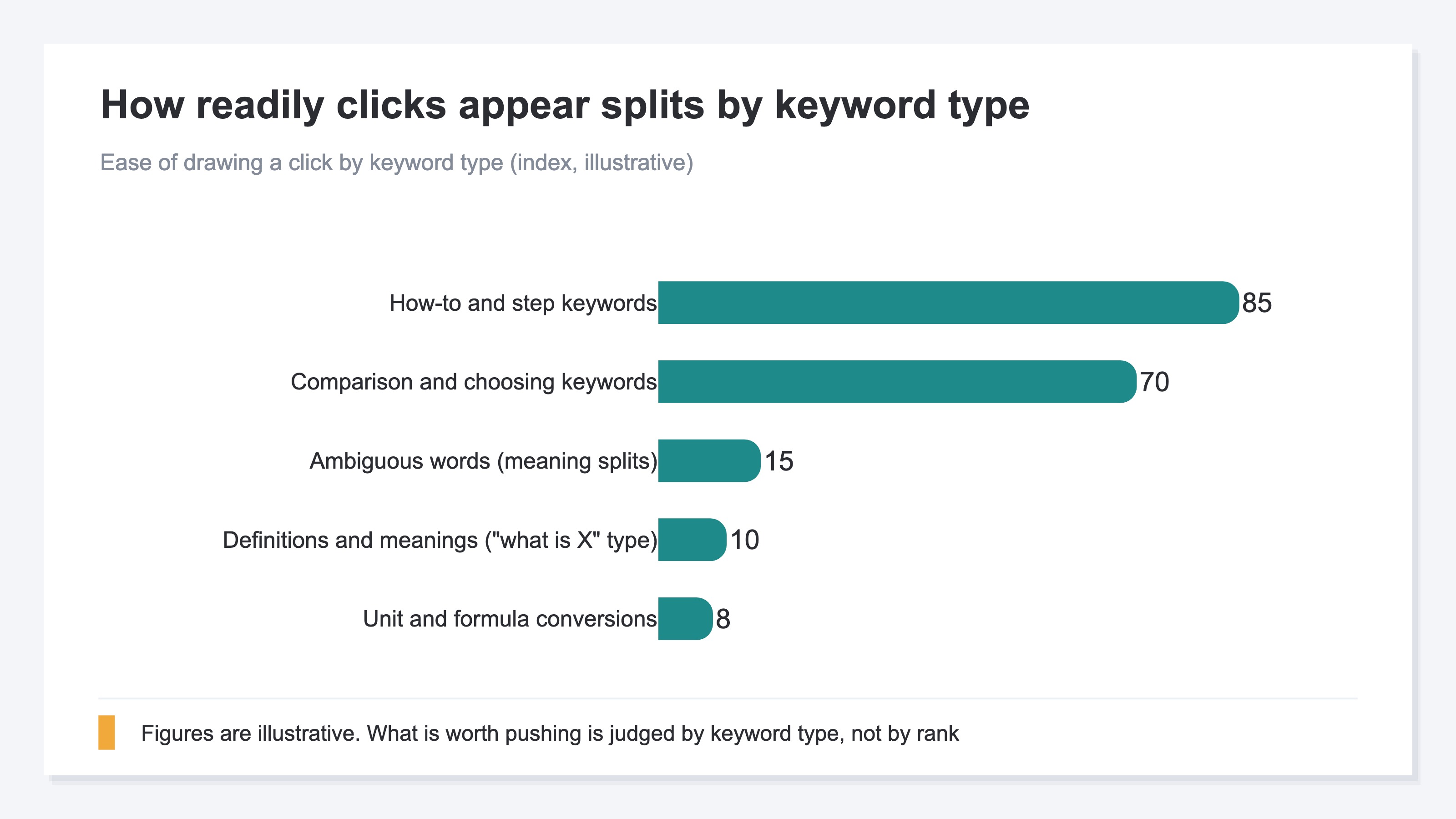
The second is finishing inside the search results page. For definitions, formulas and unit conversions, where the answer is complete on the search screen itself, readers never open the links below. In the United States, 58.5% of Google searches do end without a click anywhere[2]. A separate study reports clickless searches at 25.6% on desktop and 57% on smartphones[3].
The third is substitution by AI citation. These are keywords where the AI summary above the search results, or an answer from ChatGPT and the like, supplies the answer and stands in for the click.
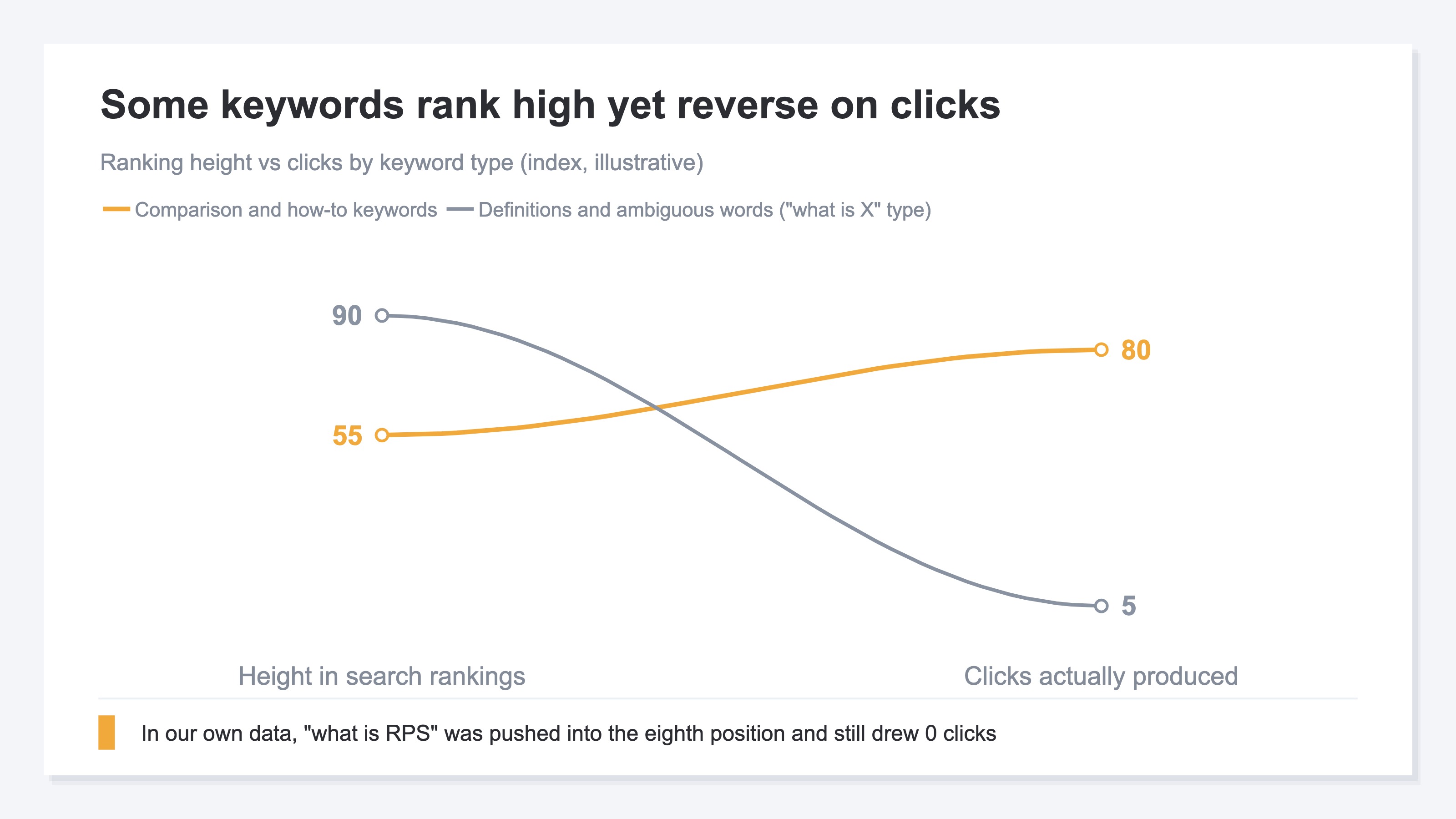
On our own site as well, when we checked the keywords sitting in the upper band of the rankings, nine out of ten were terms explaining a definition on the English pages, and the clicks were near zero. What to do with keywords that have impressions but no clicks is covered in Impressions but no clicks. Telling these types apart comes before pushing the rank.
2. Diagnose Whether the Keyword Produces Clicks Before You Push#
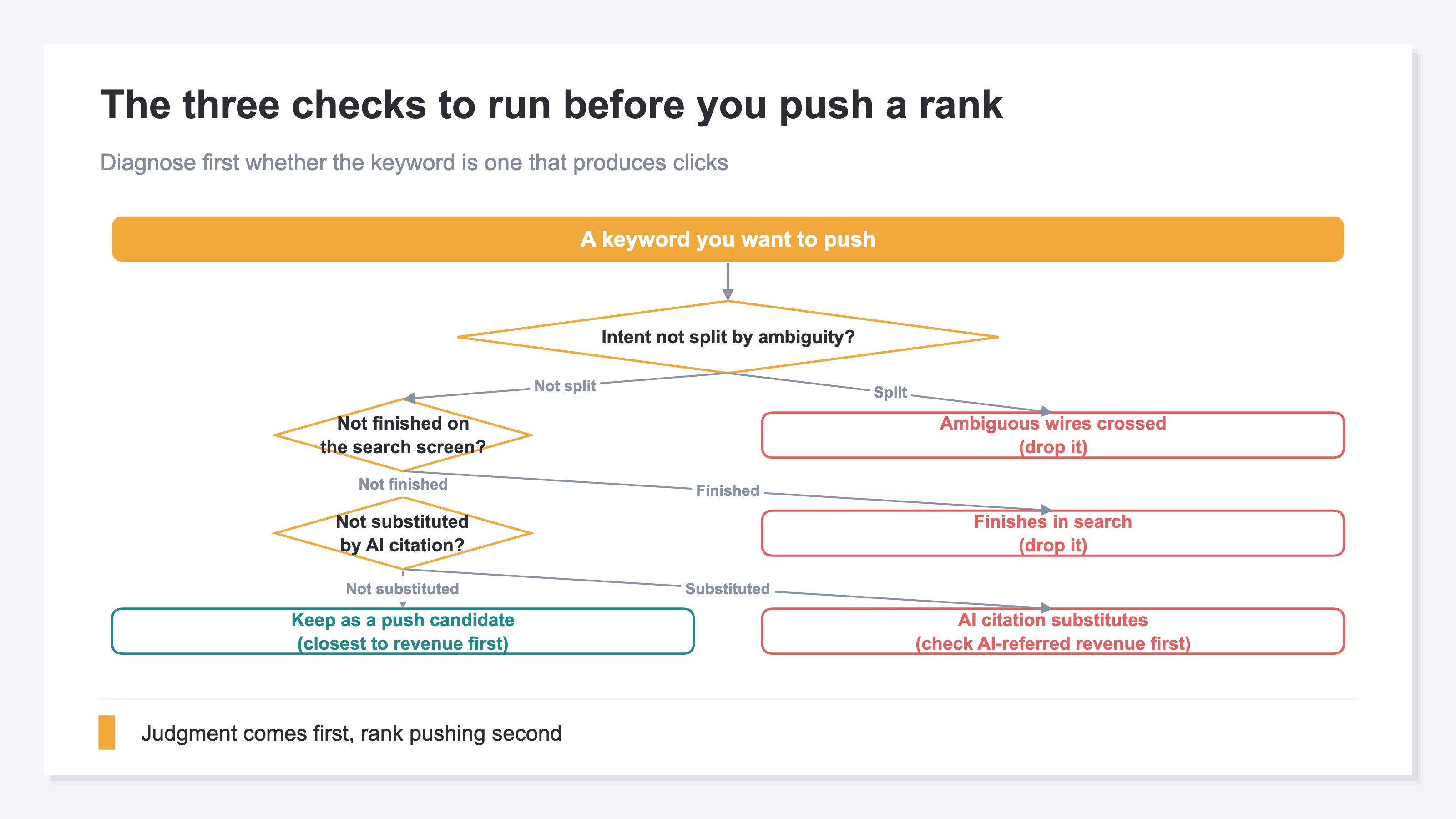
Before getting into the work of pushing a rank, confirm on three points whether that keyword produces clicks. Impressions, clicks and average position in search can be checked in Google Search Console (GSC, a free tool for seeing how you appear in search)[1]. What GSC does not show is whether the keyword is one that produces clicks.
The first point is whether the intent splits. Ambiguous keywords, and keywords where people only want to know something, split easily, and moving them up rarely turns into a visit.
The second is whether it finishes on the search screen. Definitions, formulas and unit conversions are settled inside the search results, and readers don't travel down to the links.
The third is whether an AI citation is substituting for it. Look at whether an AI summary or answer has taken the place of the click.
The diagnosis itself isn't complicated. What's hard is keeping it up. First, checking dozens to hundreds of keywords by hand on these three points every month doesn't run. Second, a judgment made by looking at search results one at a time varies from person to person. Third, whether AI is substituting for the click is hard to observe unaided. In short, the method is simple, but running it every time across every keyword is heavy.
This is a separate matter from the after-the-fact investigation of "the rank is the same but the clicks fell." Telling a loss from a win among the clicks that were lost is covered in Same rank, fewer clicks. This article sits before that, on how effort is allocated ahead of pushing a rank.
3. Reallocate Effort to the Keywords Worth Pushing#
Once the keywords that struggle to produce clicks are dropped on those three points, work the remaining keywords starting from whatever sits closest to revenue. Where a limited budget of rank-pushing effort is directed changes what comes out of it.
Which of the remaining keywords to push is decided by the upside in search and the revenue efficiency. The thinking is in Pick striking-distance keywords by revenue. The order in which to fix articles is handled separately in Which articles to rewrite first — that one is about the order of the articles you fix, this one about telling which keywords are worth pushing.
What to watch out for here is that deciding "zero clicks means failure" and rewriting mechanically can break even the pages that are earning by being cited by AI. A keyword with zero clicks whose AI-referred visits are turning into purchases loses the citation along with the rewrite if it gets changed without a check. The confirmation steps to take before fixing anything are in Don't break your winning pages when you rewrite. That one is the on-screen confirmation procedure for not breaking things, this one the diagnostic frame for whether to push at all.
Judgment comes first, rank pushing second. Ordering it this way is enough to avoid both mistakes: pouring effort into keywords that produce no clicks, and breaking the keywords that are already winning.
RevenueScope solution
RevenueScope mechanizes this three-point diagnosis. Running a per-keyword diagnosis by hand every month across dozens to hundreds of keywords is heavy work. RevenueScope classifies every page into five states in its content improvement suggestions, and attaches two suspicion flags to the pages that are risky to fix mechanically.
The first is zero-click suspicion (zero_click_suspect). It indicates that the answer may be finishing on the search results screen, or that an ambiguous keyword may be surfacing the page against the other meaning, and it acts as a cue to check the actual search result first. The second is AI citation suspicion (geo_winning_suspect). It indicates that the click may have been replaced by an AI answer. Both are suspicions, not verdicts — inferences from the shape of the numbers, not direct observation of the search results.
On top of that, how much revenue each page actually landed (landing revenue) is displayed alongside. The table below is an image of that output.
| Target page (main keyword aimed at) | Position | Impressions | Clicks | Suspicion flag | Landing revenue |
|---|---|---|---|---|---|
| Glossary page ("what is …") | 6 | 1,800 | 0 | Zero-click suspicion | ¥0 |
| Category comparison page | 4 | 640 | 12 | AI citation suspicion | ¥58,200 |
| How-to guide page | 9 | 520 | 47 | None | ¥121,400 |
An illustrative comparison of pages with and without click potential. The figures are examples used for explanation.
What characterizes this example is that pages looking alike in rank and clicks change appearance once the suspicion flag and the landing revenue are laid over them. The keyword worth pushing (how-to steps) and the word that produces few clicks however far it is pushed (a term definition) separate clearly in money. With GA4 and GSC alone, the work becomes checking search results one keyword at a time and tying them to revenue every week, which doesn't run across dozens to hundreds of keywords. RevenueScope shows the suspicion flags and the landing revenue on one screen, supplying page-by-page material for deciding which keywords deserve the effort.
FAQ#
Frequently asked questions#
Q. If the rank keeps going up, will the clicks eventually follow?
A. It depends on the keyword. Ambiguous keywords, keywords whose answer is complete inside the search results, and keywords where an AI answer stands in produce few clicks however far the rank is pushed. Confirming before you push whether the keyword is one that produces clicks keeps the effort from being wasted.
Q. Are all keywords with zero clicks candidates to be fixed?
A. No. Keywords that have impressions but no clicks and no AI-referred revenue either are candidates to fix. But keywords cited by AI and tied to revenue can lose the citation along with a rewrite if they get changed without a check. The important thing is not to settle on "zero clicks means failure."
Q. Where can I tell whether AI has taken the answer in the search results?
A. Appearance in Google's AI summaries can be seen as far as impressions in Google Search Console's generative AI report. Clicks and revenue don't come with it, and traffic from other AI such as ChatGPT isn't included. What matters is not reading a rise in impressions as a rise in revenue.
Summary#
Some keywords gain no clicks even after the rank goes up. The cause isn't the rank — it's whether that keyword produces clicks. Ambiguous keywords whose meaning splits, answers that finish inside the search results page, and substitution by AI citation: these three obstruct clicks for reasons that have nothing to do with the effort spent pushing a rank.
So before pushing a rank, confirm three points: whether the intent splits, whether it finishes on the search screen, and whether an AI citation is substituting for it. Drop the keywords that struggle to produce clicks, and work the remainder starting from whatever sits closest to revenue. Judgment comes first, rank pushing second. Start with one keyword that has been bothering you, and check whether it is a keyword that produces clicks at all.
See which ads actually drive revenue, at a glance
Free up to 5,000 sessions/month, AI analyst included. No credit card required. Up and running in 5 minutes.