![[Study] 100 Blogs, 85% Traffic Drop: What the Survivors Did Differently](/_next/image?url=%2Fimages%2Fnews%2Fblogging-traffic-collapse-survival.jpg&w=3840&q=75)
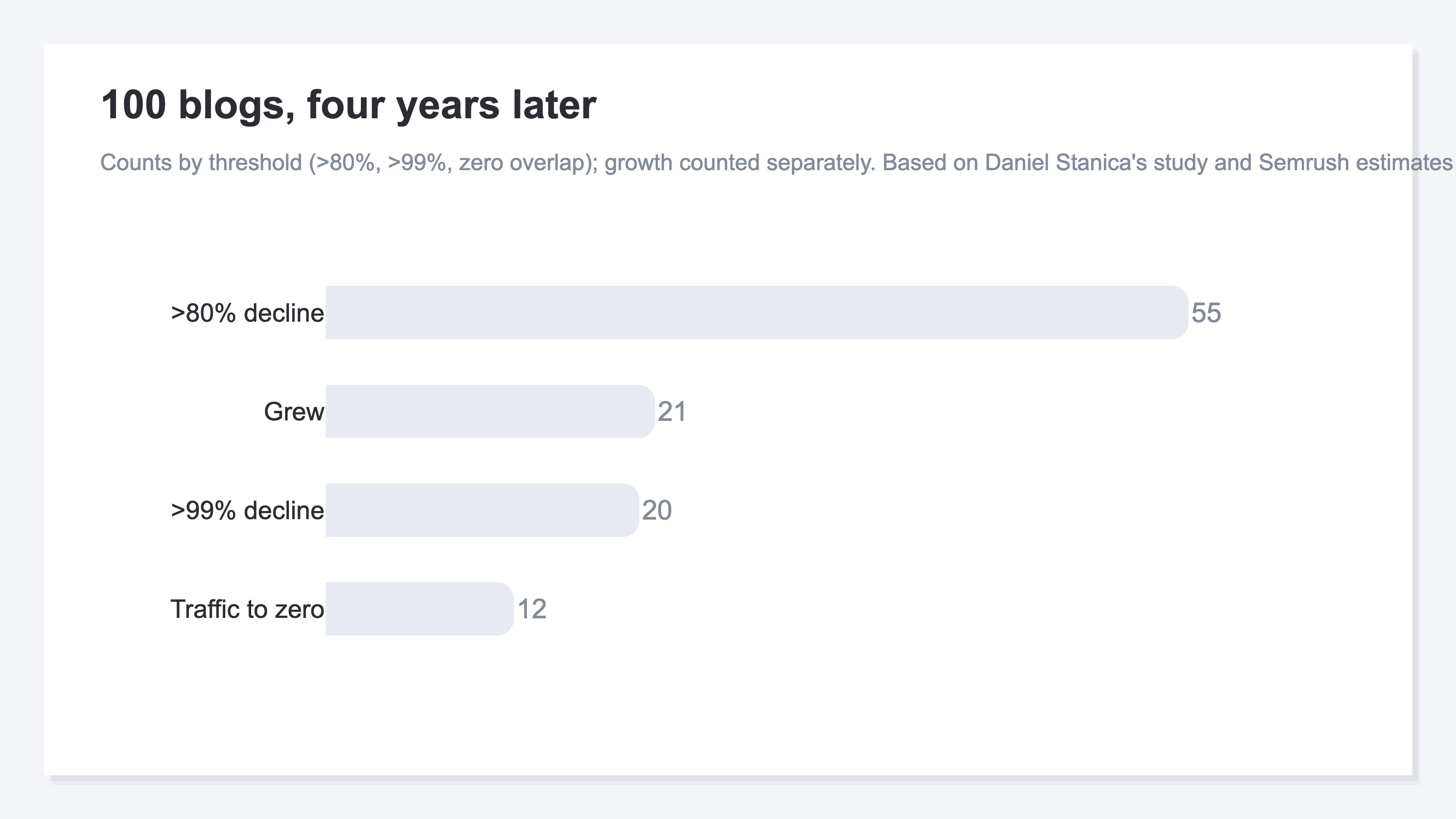
A study titled "The Great Blogging Collapse" has been making the rounds. Daniel Stanica (Monetize Better) tracked the search traffic of 100 blogs over four years, from 2022 to 2026. The result: a median drop of 85%. More than half the blogs lost over 80% of their traffic, and 12 saw their organic traffic hit zero.
Here's the conclusion first. This decline isn't a temporary ranking swing — it's a structural shift driven by AI Overviews and Google's experience-focused updates. That's why fighting to "get the traffic volume back" is a losing game. And yet, over the same four years, 21 blogs grew. What the survivors had in common: first-hand experience no machine can imitate, a real brand behind the site, and a habit of judging traffic not by volume but by its quality toward revenue. In this article we'll look at what the study found, what separated the survivors, and how to swap the metric you chase from pageviews to landing revenue.
Table of contents
TL;DR#
-
100 blogs tracked for four years — search traffic down a median 85%
55 blogs lost over 80% of their traffic, and 12 fell to zero organic. Meanwhile 21 grew. The study is by Daniel Stanica (Monetize Better), based on Semrush estimates
-
The decline is structural, and it isn't reversing
AI Overviews answer the query right on the results page, and experience-focused updates devalued "articles an AI could write." Neither change is moving backward
-
Survivors shared at least three of four traits
First-hand experience no machine can generate or summarize / an audience you own, like email / a brand people search by name / a real product. What vanished were article farms with no real business behind them
-
The metric to chase is landing revenue, not pageviews
Traffic volume is no longer a number you control. What matters is which landing pages turned incoming traffic into how much revenue — seen through RPS after bot exclusion, the way the survivors run their sites
1. What happened: 100 blogs tracked for four years#
Bottom line: A study tracking 100 blogs over four years found search traffic down a median 85%. More than half lost over 80%, and only 21 managed to grow.
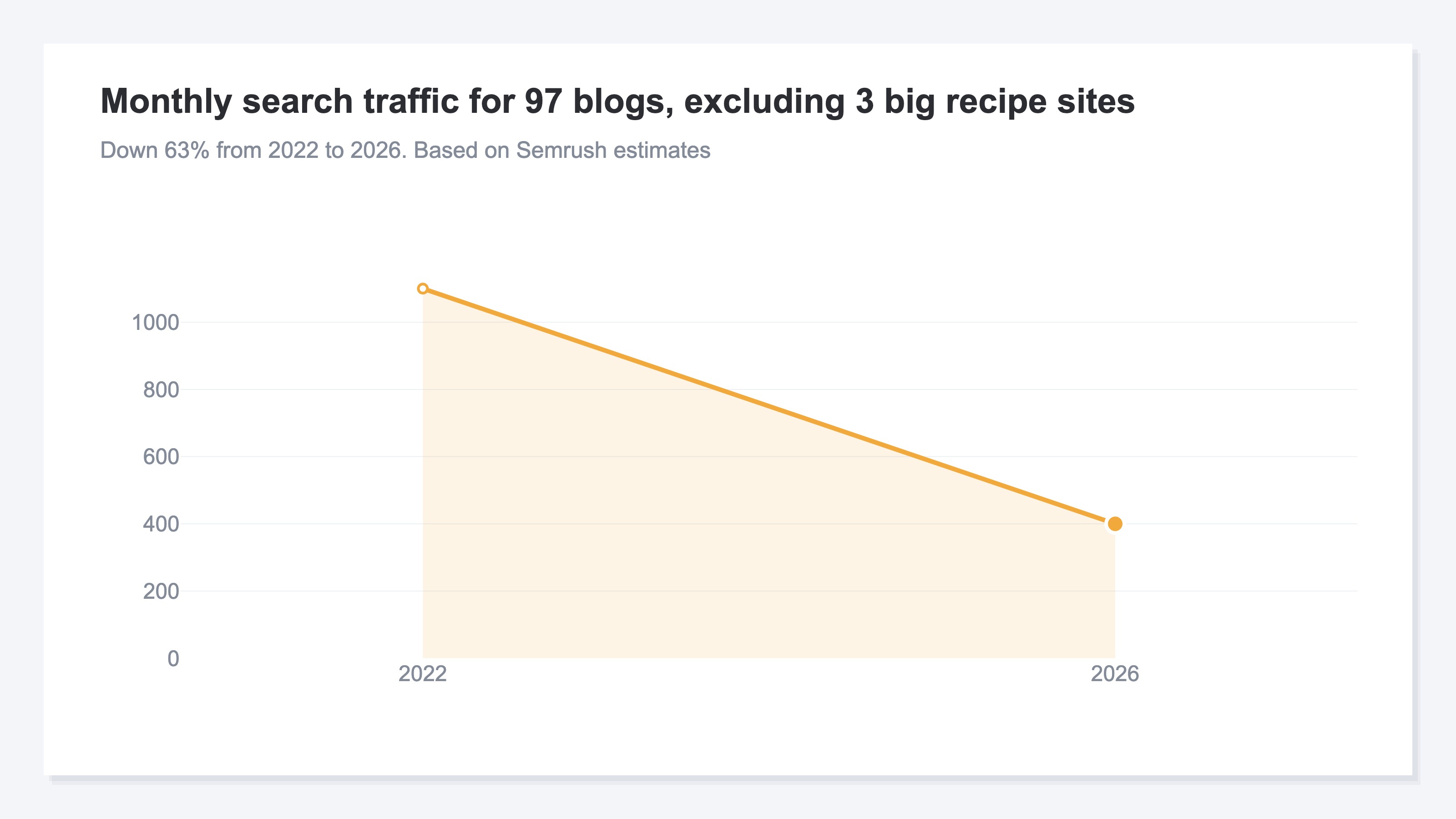
The study comes from Daniel Stanica (Monetize Better), who publishes on blog monetization[1]. From 2022 to 2026, he tracked the search traffic of 100 blogs using Semrush estimates. Breaking it down: of the 100 blogs, 55 saw search traffic fall by more than 80%. Twenty lost over 99%, and 12 hit zero organic traffic. Combined monthly traffic across all 100 sites went from 17.8 million visits to 12 million. Narrow it to the 97 blogs excluding three large recipe sites, and monthly traffic dropped from 11 million visits to 4 million — a 63% decline. The combined total is being propped up by a handful of large sites; the majority sank far deeper.
One caveat up front: these figures are Semrush estimates, not each site's measured analytics. Even so, a change this consistent across 100 sites can't be explained by individual ranking swings. Real-world cases match the pattern: a major blog that once drew 20,000 daily visits fell to 600. Another with 150 well-regarded, high-quality articles watched daily traffic sink from 140 to 15–30. Article quality alone couldn't save them. That is what happened over these four years.
2. Why the search traffic isn't coming back#
Bottom line: The decline in search traffic isn't a temporary ranking swing — it's structural. AI Overviews complete the answer right on the results page, and experience-focused updates devalued "articles an AI could write." Neither change is moving backward.
AI Overviews place an AI-generated answer at the very top of search results. Users get what they need there and leave without clicking a single link. The articles that vanish first are the question-shaped ones — "what is X," "how to do X," "X vs Y." When the AI answers the question directly, there's no reason left to visit the article. The other force is Google's series of updates favoring first-hand experience[2]. Articles that merely tidy up general knowledge — in other words, articles an AI could write — lost their standing. Put bluntly, Google decided it doesn't need what an AI can produce.
In short, Google is shifting from a place that distributes traffic to an answer engine that resolves the query on the spot. No ranking tactic can reverse that current. At the same time, a new kind of traffic is emerging — visitors arriving via answers from ChatGPT and other AI tools (How to read AI-engine traffic and its revenue). The accurate framing is that the map of traffic itself is being redrawn.
3. What separated the 21 survivors from the blogs that vanished#
Bottom line: The 21 blogs that survived shared common traits: first-hand experience no machine can generate or summarize, an audience they own through email or community, a brand people search by name, and a real product. Survivors met at least three of these four conditions.
Seen from the other side, what vanished were blogs run as standalone sites with no real business behind them. If you compress Google's verdict in this shake-out into one line, it's "if you're a content farm, you're not needed." By contrast, blogs running on the same domain as a product stayed stable through all four years of turbulence. The blog brings the product prospective customers; the product lends the blog the credibility of a real business. They feed each other. Being a brand people search for by name matters even more in the AI-search era, because whether AI answers cite you by name decides your next front door (Brand visibility in AI search).
These four conditions are not a playbook that brings the traffic back. First-hand experience and a brand aren't things you can assemble by tomorrow. What this study really asks sits further upstream: do you keep running your site with traffic volume as the goal? The survivors weren't judging their traffic by volume.
4. Track landing revenue, not traffic volume#
Bottom line: In an era where search traffic declines structurally, the number to hold onto is landing revenue, not pageviews. Not how much traffic came, but which channel and which landing page turned that traffic into how much revenue. The survivors have already made this swap.
Traffic volume has become a number you can't control — it moves at the whim of AI Overviews. The quality of the traffic that does arrive, meaning its conversion to revenue, is something you can measure and improve. Among site operators overseas, the recognition has spread that conversions now matter far more than raw traffic, and the steering has shifted toward owning your own channels, like email, rather than treating Google as the only entrance. For ecommerce operators, this means swapping metrics. What to watch isn't the rise and fall of session counts. It's how much revenue organic search actually carries (How to measure organic search's revenue contribution), and which landing pages receive that revenue most efficiently (Landing page revenue efficiency).
Here's one metric worth knowing: RPS — revenue per session. It lets you compare traffic quality across channels with a single number. The catch is that producing it routinely in GA4 is heavy work: splitting revenue by channel, removing bots (automated visits), and redoing the math by hand every time. The idea is simple, but repeating it weekly across channels is more than most teams can spare hands for. This is where we come in.
RevenueScope Solution
Bottom line: RevenueScope puts channel-level landing revenue and RPS on one screen, using clean numbers after bot exclusion. It's a measuring instrument for the era of shrinking traffic — built so you can judge, by revenue, which traffic deserves your attention.
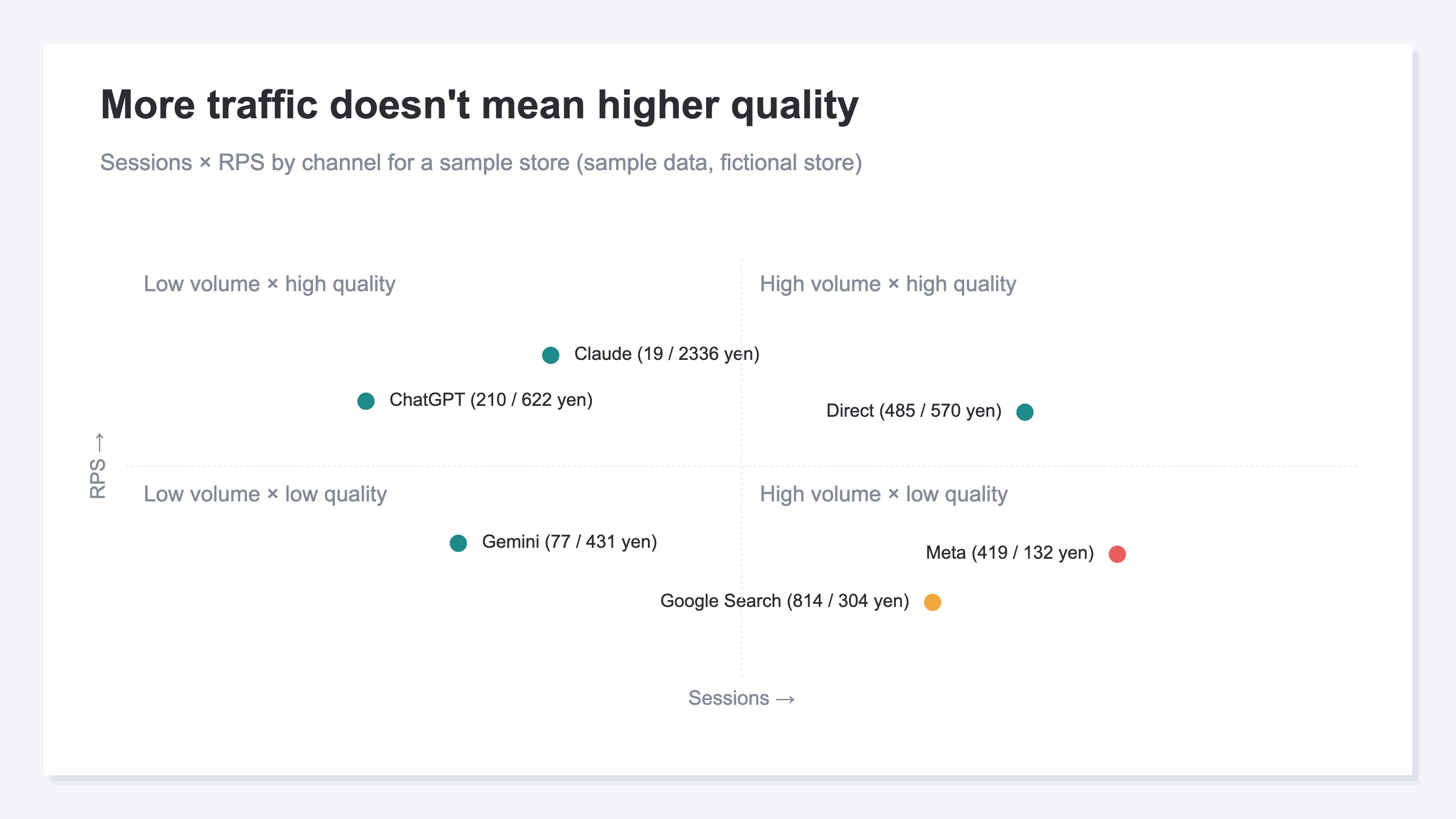
Here's what it actually looks like. This is 90 days of channel-level sessions and RPS from the fictional sample store ("Sample EC Store") in the RevenueScope demo.
| Channel | Sessions | RPS (¥) |
|---|---|---|
| Google Search | 814 | 304 |
| Direct | 485 | 570 |
| Meta | 419 | 132 |
| ChatGPT | 210 | 622 |
| Gemini | 77 | 431 |
| Claude | 19 | 2,336 |
Google Search brings the most traffic (814 sessions) at an RPS of ¥304. Meanwhile, Claude-referred traffic — just 19 sessions — runs at an RPS of ¥2,336. Volume and quality are different things, and this one table shows it. Watching traffic volume alone, you'd dismiss Claude referrals as noise. Yet each visit is worth more than seven times a Google Search visit. As search traffic structurally declines, what operators need to hold isn't "how much came" but "which landing pages turned the traffic that came into how much revenue." RevenueScope shows this with post-exclusion numbers, so padded traffic doesn't jerk your judgment around.
What RevenueScope takes on is connecting the quality of incoming traffic to revenue so you can act on it. It puts channel-level landing revenue and RPS on one screen, in clean numbers after bot exclusion — a measuring instrument that lets you decide, by revenue, which traffic deserves your attention in an era of shrinking traffic.
FAQ#
Q. Does the study's "85% drop" apply as-is to blogs in Japan?
A. Not as a literal number. The study centers on English-language sites and carries the limitation of being based on Semrush estimates. But AI Overviews and experience-focused evaluation are both advancing in Japanese search results too, and the direction is the same. The reliable move is to verify with your own numbers.
Q. If I meet the four survivor conditions, will my search traffic come back?
A. They're not conditions that promise recovery. The four traits are what the resilient side had in common — not a playbook for restoring traffic. What matters more is rethinking whether traffic volume should stay your goal at all. Anchor on landing revenue and the priority of your next moves changes.
Q. Can GA4 tell AI-referred traffic apart?
A. Partly, by inspecting referrers — but GA4's default channel grouping doesn't gather AI traffic into one view, so manual sorting is required (Measuring AI Mode traffic in GA4). RevenueScope automates that sorting: it separates AI-referred traffic by channel and shows revenue and RPS after bot exclusion, on one screen.
Wrap-up: swap the metric you chase#
What the four-year tracking of 100 blogs showed is that the decline in search traffic is not a passing wave but a structural shift. A median 85% drop; 12 sites down to zero. Even so, 21 grew. The dividing line: first-hand experience no machine can imitate, and being a brand with a real product behind it. And judging traffic not by volume, but by its quality toward revenue. Traffic volume is no longer a number you control. What you can control is which landing pages receive the traffic that comes, and how much revenue it turns into. Swap the metric you chase from pageviews to landing revenue — that is the single biggest lesson to take home from this study.
See which ads actually drive revenue, at a glance
Free up to 5,000 sessions/month, AI connection included. No credit card required. Up and running in 5 minutes.


![[Research] How Visible Is Your Brand in AI Search? You Can Measure It](/_next/image?url=%2Fimages%2Fnews%2Fai-search-brand-visibility.jpg&w=3840&q=75)


![[Research] More AI Traffic Isn't Proof It Worked: Tell the Real Gain by Revenue](/_next/image?url=%2Fimages%2Fnews%2Fai-referral-revenue-real.jpg&w=3840&q=75)