When you set aside budget for EC acquisition for the first time, which should you fund first—SEO or paid ads? It's a spot where everyone hesitates. The short answer: rather than picking one of two, the practical move is to compare the earning power of both on a single yardstick—the revenue one session generates (RPS)—and let cash runway and speed decide the order you invest in.
Why not think of it as an either/or? Because SEO and paid ads are opposite in how time and money behave, and comparing only a single moment's revenue unfairly underrates SEO while it's still ramping up. If you want a bird's-eye view of acquisition channels first, comparing EC acquisition channels by revenue is an easier way in—but this article goes further, narrowing to SEO and ads and how to decide which to fund first.
Contents
This article in brief#
- SEO and paid ads are opposite in how time and money behave. Ads work from today but are a cost you keep paying, and stop the moment you stop; SEO takes weeks to months to work but, once it takes, becomes an asset that compounds. So comparing only revenue at the same instant makes you underrate SEO while it's still ramping.
- What you can compare on a level field is earning power—RPS (the revenue one session generates). Comparing by totals or counts just makes the bigger channel look better; normalizing to RPS lets you compare purely how much a single visit earns.
- The judgment has two stages. First compare earning power with RPS, then layer a cost lens (ROAS) on the ad side only. Which to fund first is decided in this order: do you need revenue this month, do you have the cash runway to wait for results, and which is higher on RPS.
1. SEO and paid ads are opposite in time and money#
The first thing to grasp: ads are "fast-acting but a cost you keep paying," and SEO is "slow-acting but an asset that piles up"—time and money point in exactly opposite directions.
Paid ads (listing/search ads) start drawing clicks the very day they clear review[2]. The effect is fast, but the cost recurs every month, and stop paying and traffic falls back to near zero. It's a faucet: you get exposure only for as much as you pay.
SEO, by contrast, takes weeks to months for an article or product page to be rated by search and climb to the top. Google itself notes that it takes time for the effect of your work to show up in search results[1]. But once you're on top, traffic piles up with no extra ad spend, and pages you wrote in the past keep working as assets. How organic search feeds into revenue is covered separately in measuring organic search's revenue contribution.
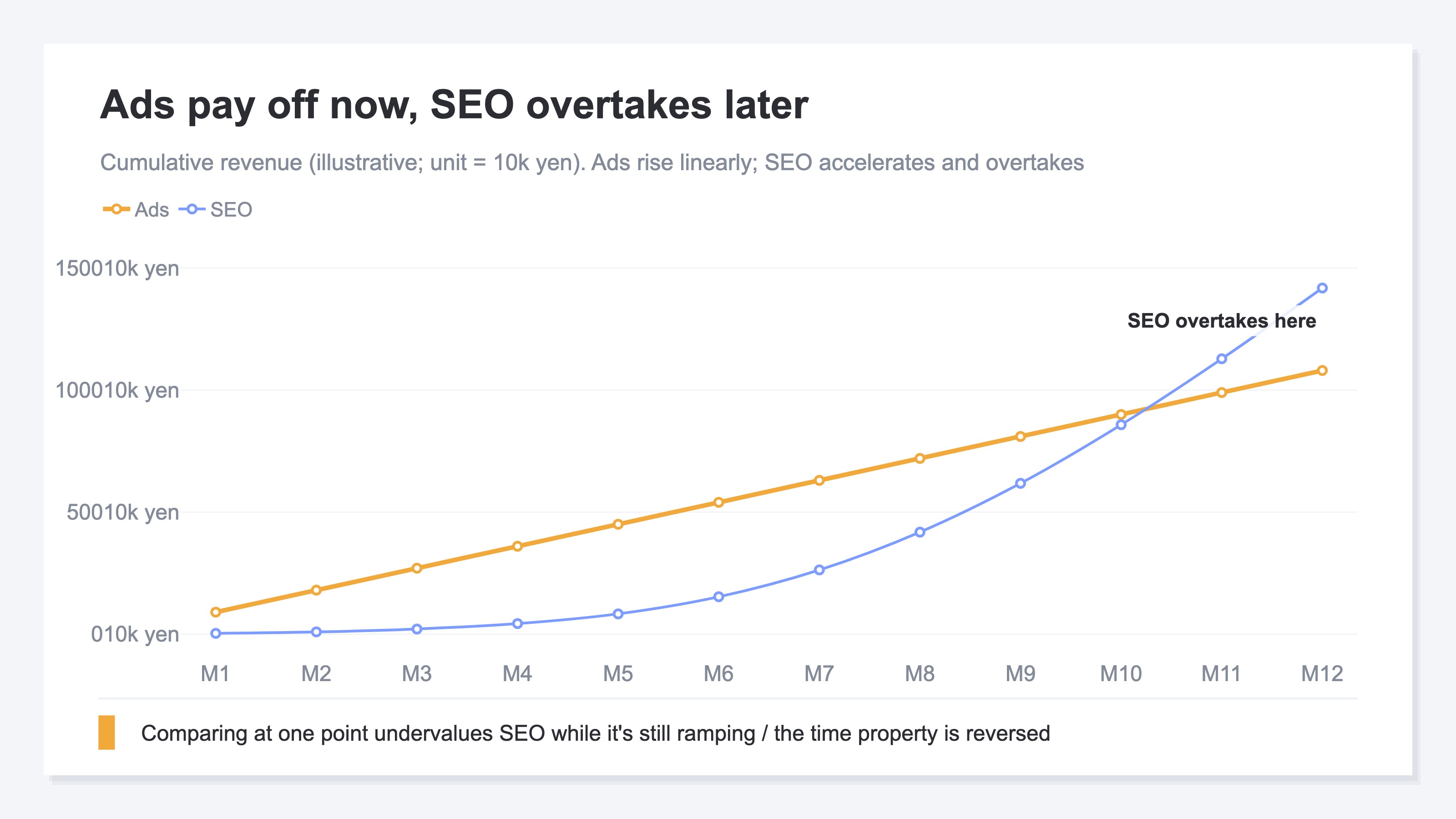
The figure above sketches cumulative revenue as an illustration. Ads rise in a straight line at a steady pace from the first month. SEO stays nearly flat at first, accelerates later, and in this example overtakes ads around month 11. What matters here is that comparing these two lines by a single-moment snapshot—"which is higher right now"—makes you unfairly underrate SEO while it's still in its flat stretch. Slicing two things with opposite time axes at the same instant just doesn't line up. So what you need to change is the yardstick you compare with.
2. The same yardstick, RPS, finally lets you compare#
The yardstick that lets you compare fairly even when the time axes are opposite is RPS (Revenue Per Session—the revenue one session generates). Seen through RPS, you can compare SEO and ads on the same field for earning power alone.
RPS is revenue divided by the number of sessions (covered in detail in a plain explanation of what RPS is). Compare by totals or counts and a larger-scale channel looks better for that alone. RPS normalizes to a single session, erasing differences in scale so you compare purely how much one visit earns. One note: what this article calls "organic search" is non-ad traffic that arrives via search engines like Google Search or Yahoo! Search. On analytics screens it's usually broken out by search engine, so from here on the figures use Google Search as the representative.
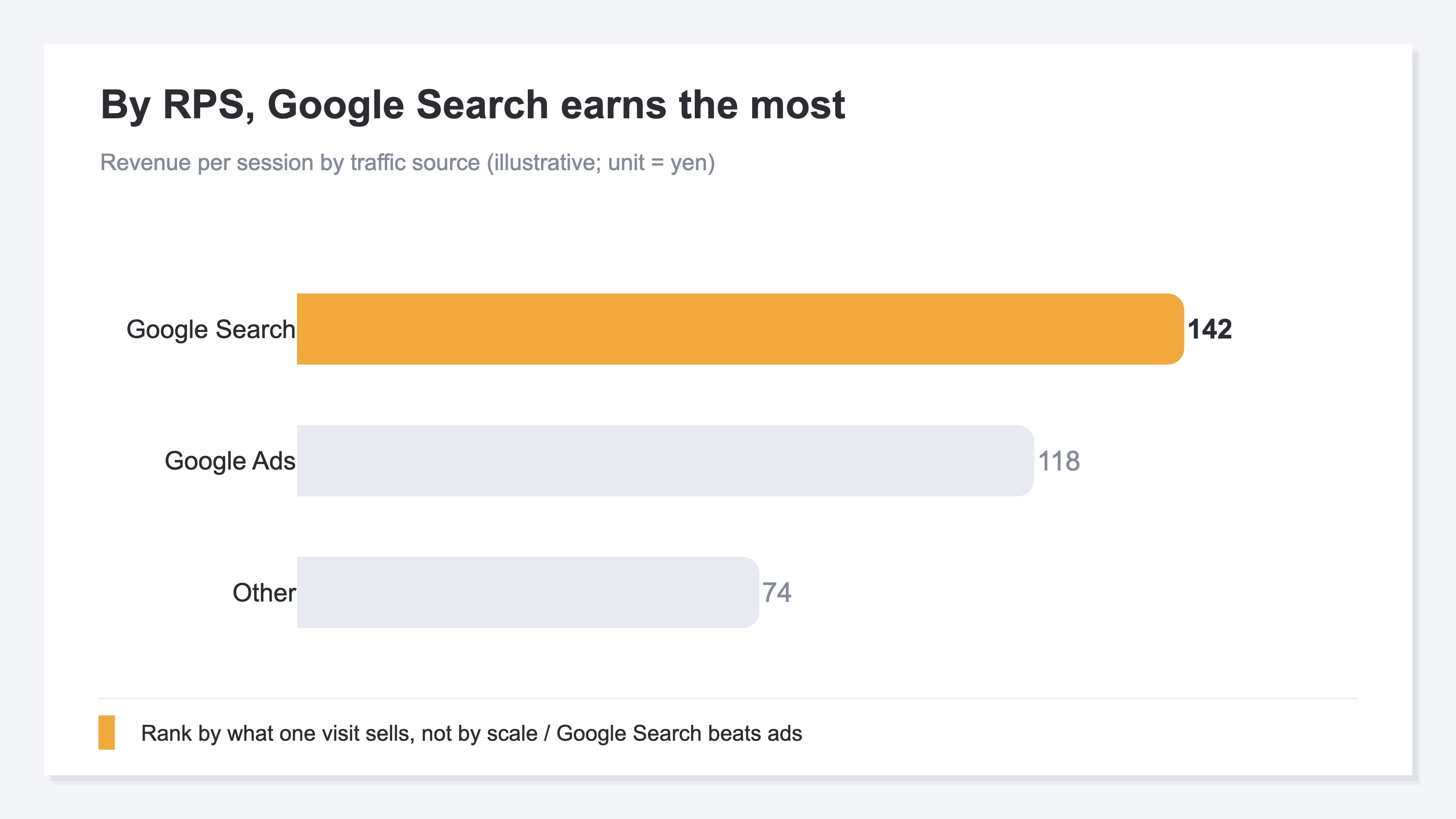
The figure is illustrative, but the ordering where organic search's RPS beats ads does happen often in practice. Organic-search visits, from people who come with intent and search on their own, can sell more per visit than ads shown by interruption.
The caution here is that RPS is "earning power," not "cost-effectiveness." Ads have an obvious cost in ad spend, and ROAS (the multiple of revenue over ad spend, explained in what ROAS is) shows cost-effectiveness too. Standard search tools, meanwhile, give you impressions, average position, and clicks—but not how much that session sold[3]. The effort of producing articles on the SEO side also sits outside web analytics. So what you can honestly compare on the same yardstick reaches only as far as earning power—RPS—while the cost lens (ROAS) can be layered on the ad side alone, after the fact. That's the asymmetry. The judgment is two-stage: first line up earning power with RPS, then confirm the ad side's economics with ROAS—split that way, it lines up.
3. Which to fund first: decide by runway and speed#
Which to fund first is better decided by investment order than by cutting it into an either/or. The core of the method runs in this order: do you need revenue this month, do you have the cash runway to wait for results, and which is earning more on RPS.
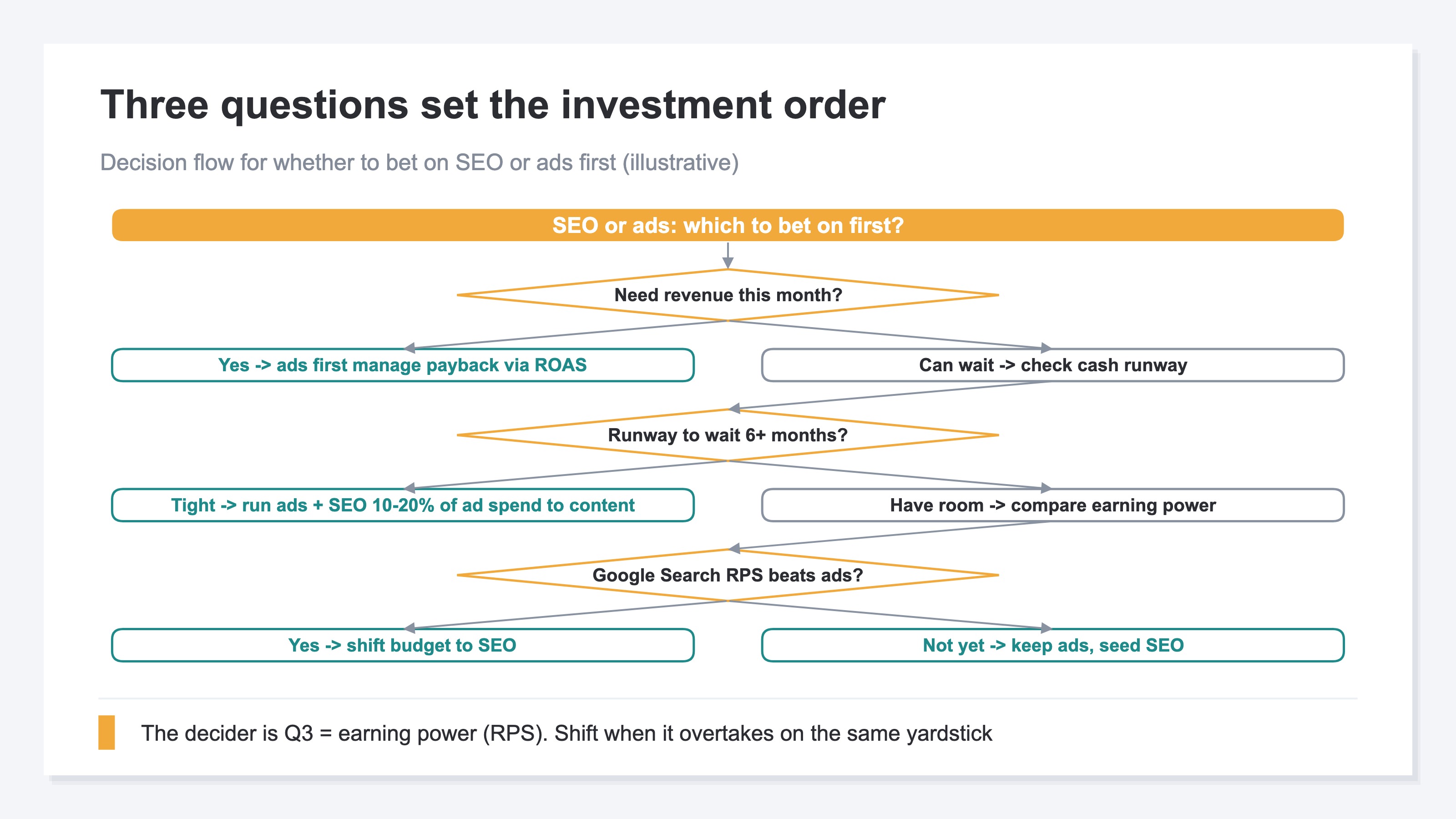
Let's walk the flow above. The first question is whether you need revenue from this month. If you do, start with ads, which bring traffic from day one, and run them while managing economics with ROAS. Which ad channel to start with is covered concretely in choosing your first ad channel by RPS.
If immediate revenue isn't a must, ask about cash runway next. If it's hard to afford waiting six months or more for results, run ads and SEO in parallel. You secure current revenue with ads while routing 10–20% of ad spend into article production to grow SEO assets. Without cutting either, you build income and assets at the same time.
If you can afford to wait, judge by RPS last. If Google Search's RPS is above ads' RPS, shift investment to SEO—it's already winning per session and it's a compounding asset on top of that. If it's still below, keep ads as the axis while seeding SEO. Whichever branch you land on, the core of the judgment is RPS. Look at earning power in numbers first, then let cash runway and speed decide the order.
RevenueScope solution
The judgment so far keeps hitting the same wall. To compare earning power you want RPS lined up by traffic source, with ROAS layered on for ad channels. But with standard tools you end up hand-matching search data—which only goes as far as clicks—against ROAS on the ad side, across channels, over and over.
RevenueScope solves this matching. It shows sessions, revenue, and RPS by traffic source on one screen, and for ad channels, import ad spend and it layers on ROAS too. Below is an example ordering on demo data modeled on a cosmetics EC store.
| Traffic source | Sessions | Revenue | RPS | ROAS |
|---|---|---|---|---|
| Google Search | 12,400 | ¥1,760,800 | ¥142 | — |
| Google Ads | 8,600 | ¥1,014,800 | ¥118 | 320% |
| Other (social, direct, etc.) | 9,800 | ¥725,200 | ¥74 | — |
Illustrative. The numbers are one example from a sample-data fictional site (a cosmetics EC store).
In this example, Google Search's RPS is ¥142, about 1.2× Google Ads' ¥118. At the same time, the ads pencil out at 320% ROAS. So it isn't a matter of cutting to one of two: the investment order shows up directly—lean investment toward Google Search, which wins on earning power, while keeping ads running as long as they pencil out. Google Search has no ad spend, so its ROAS cell is a dash, but earning power—RPS—can still be compared on the same footing. As a next move, switching the attribution model (last-click, first-click, linear, time-decay) lets you test how revenue leans toward each channel. You can see the actual re-sorting screen on the demo screen.
FAQ#
Frequently asked questions#
Q. SEO or ads—which is the better deal in the end?
A. Comparing gain or loss by a single moment's revenue alone makes you underrate SEO while it's still ramping. The practical move is to line them up by earning power (RPS) and let cash runway and speed decide the order you fund first. Think of it in this order: if you need revenue this month, ads; if you have the runway to wait and SEO is higher on RPS, go to SEO.
Q. How do I use RPS and ROAS differently?
A. RPS is "how much one session sells"—earning power—and it lets you line SEO and ads up on the same yardstick. ROAS is "how many times over ad spend you sold"—cost-effectiveness—and it can be layered only on the ad side, which has ad spend. Use them in stages: first compare earning power with RPS, then confirm the ad side's economics with ROAS.
Q. If I stop ad spend, will SEO alone keep things running?
A. Not right away. SEO takes weeks to months to work, and traffic is still piling up in the meantime. If you secure current revenue with ads while routing part of that ad spend into article production to grow SEO assets, you can bring the crossover forward. Rather than cutting one side abruptly, it's safer to run them in parallel and leave a stretch to grow the assets.
Conclusion#
SEO and ads are opposite in how time and money behave. Ads are fast-acting but a cost you keep paying; SEO is slow-acting but an asset that piles up. So comparing only revenue at the same instant unfairly underrates SEO while it's still ramping. What you can compare fairly is earning power—RPS (the revenue one session generates).
The judgment was two-stage. First line up earning power with RPS, then layer the cost lens (ROAS) on the ad side alone. Which to fund first is decided in this order: do you need revenue this month, do you have the cash runway to wait for results, and which is higher on RPS. Start by lining up organic search and ads on RPS and comparing them by earning power. It's the numbers on one yardstick, not a two-way hunch, that set the order you invest in.
See which ads actually drive revenue, at a glance
Free up to 5,000 sessions/month, AI analyst included. No credit card required. Up and running in 5 minutes.