
Are you dropping keywords that Keyword Planner reports as "zero search volume," deciding they have no value? Terms whose search counts are too small to be measured are the most numerous of all, and added together they account for about half of the clicks a site actually receives. This article lays out how many clicks and how much revenue zero-volume long-tail terms produce, using 90 days of measured data from our own site and avoiding jargon.
Contents
TL;DR#
- A keyword that Keyword Planner reports as zero search volume is not necessarily worth zero. Its search count is simply too small to be measured, and clicks are still happening
- Low-volume keywords (the long tail) come in enormous variety, so the total gets large. Over 90 days on our own site, 79% of the keywords that received clicks were long-tail, and they carried 52% of all clicks
- Most tools that estimate search volume only look at the measurable keywords at the top. Volume zero means outside the measurement, not value zero
- Which long-tail terms you work on is decided by estimated revenue and the change vs. the prior period, not by click count. A term that earns revenue and has started to slip is something to protect before you rewrite anything
1. Is Zero Search Volume Really Worthless?#
Keywords reported as zero search volume are producing clicks all the same. Keyword Planner shows a rough monthly search count, but keywords with few searches are not measured and get rounded to zero or to a very small band[2]. That zero does not mean "nobody searches this." It means "not searched often enough to measure reliably."
First, a word on how this article uses its terms. Line search terms up in order of search count and you get a small number of frequently searched keywords at the top (the head), followed by countless small keywords behind them (the long tail). In this article, a search term with two clicks or fewer over 90 days is long-tail, and three or more is head. Deciding where the line sits before anything else keeps the share figures from drifting.
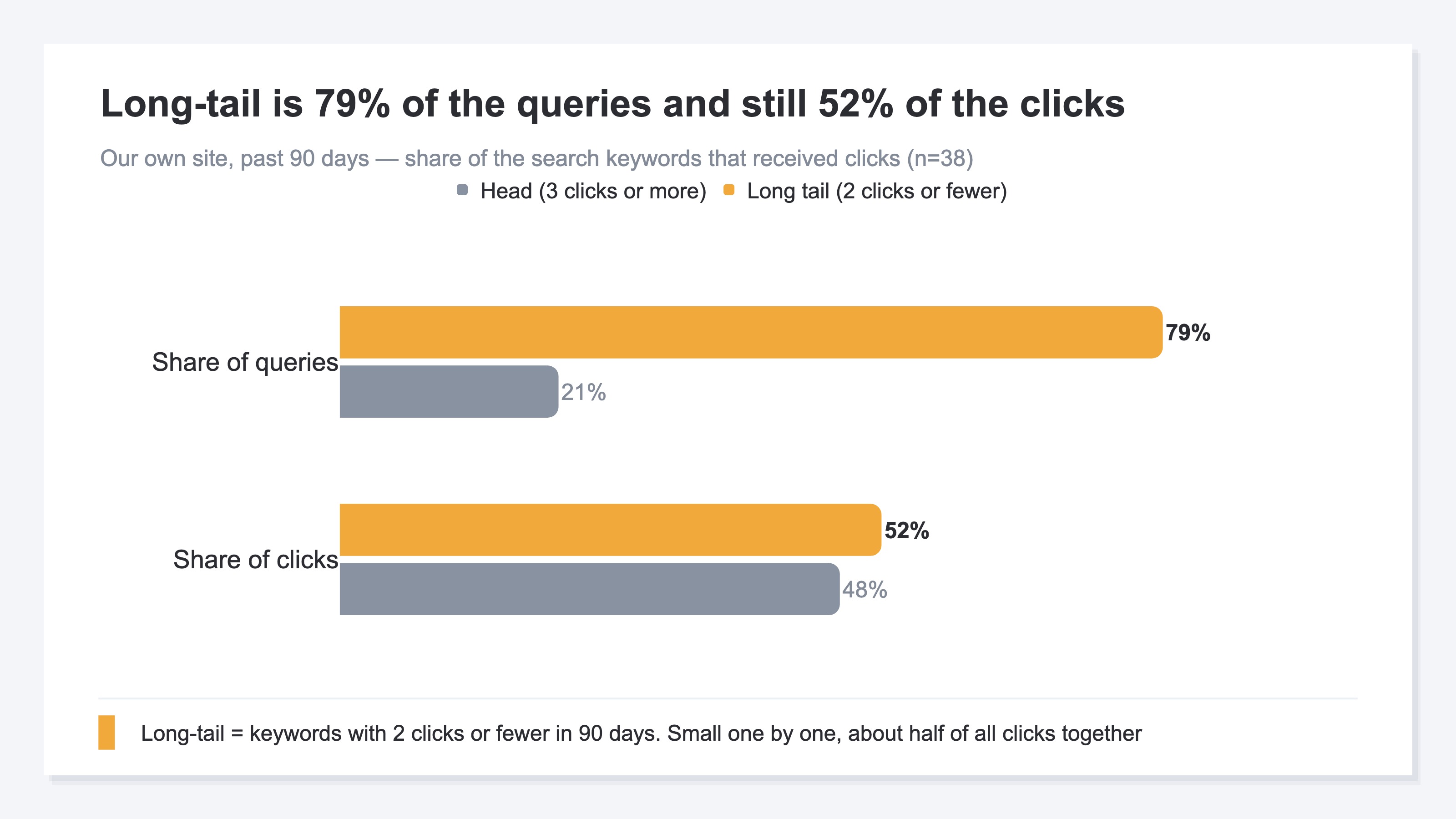
Looking at the search results for our own site (revenuescope.jp) over the past 90 days, 79% of the search keywords that received clicks (n=38) were long-tail. By count, the long tail is nearly all of it. And that 79% carried about half of all clicks over the 90 days — 52% of them. Each term is small on its own, but added up, half of the search clicks arrive from the long tail.
This share comes from our own measurement, and because we do not sell products, it is not EC revenue. The shape it describes — the long tail carrying much of the clicks — comes out of how search itself works, and it happens whatever the industry.
One note on scope: this article deals with the real-world value of keywords that never appear in search volume figures. Which of your near-miss rankings to push first is covered in picking striking-distance keywords by revenue, keywords that rank well but still don't get clicked in why rankings rise but clicks don't, and articles at zero clicks that AI still cites in zero-click articles that AI chooses. Each works on a different axis.
2. Why Low-Volume Keywords Carry Half the Clicks#
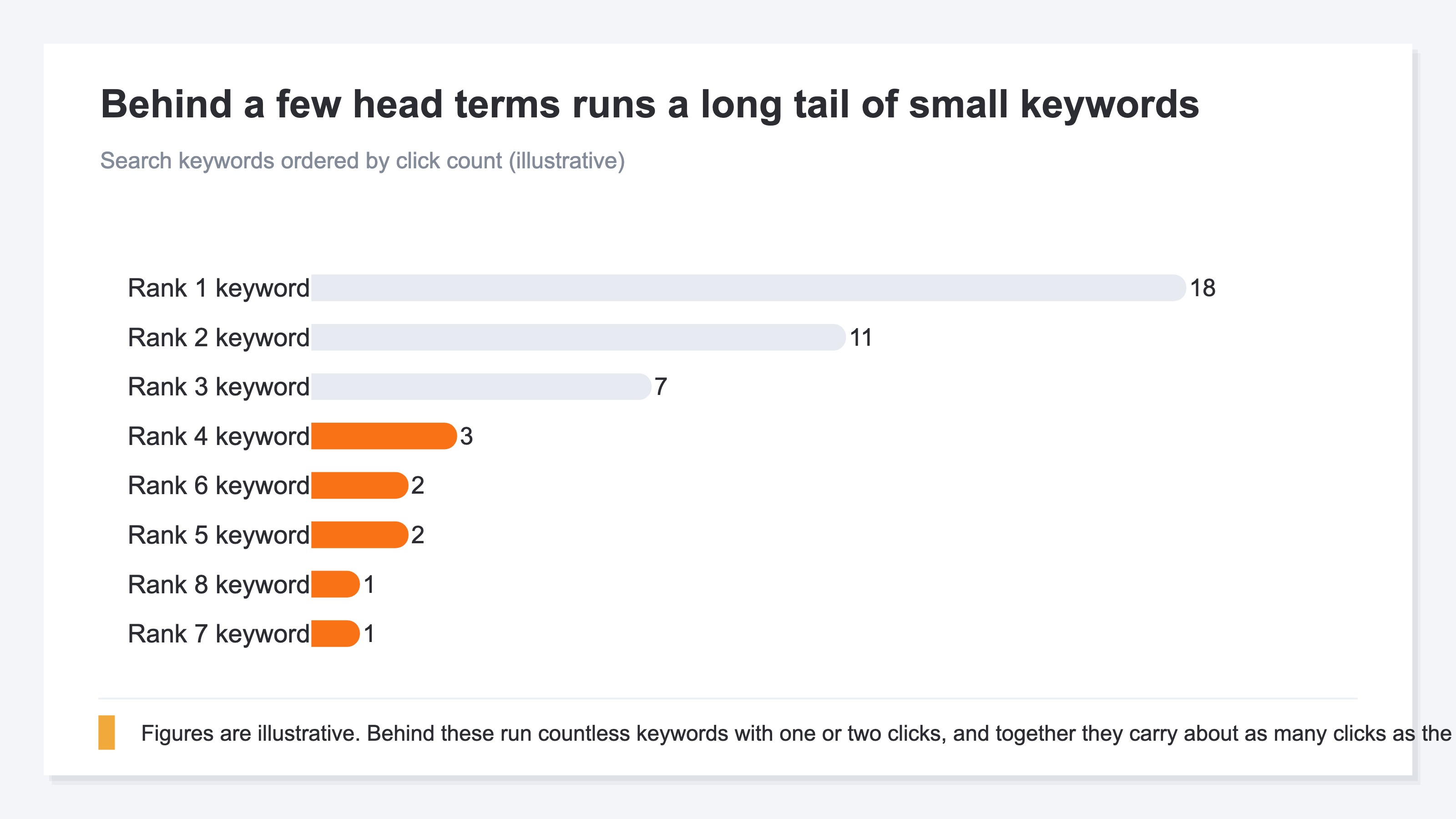
Because a single one of those keywords brings few clicks, but there are so many of them that the total gets large. Head keywords can be counted on your fingers; long-tail keywords are without number. Add them up and the collection of small keywords draws level with the head, or passes it.
One reason is that long-tail wording is specific. 敏感肌 化粧水 かゆくなる (toner for sensitive skin, makes it itch) says far more about what the searcher is after than 化粧水 (toner) does. If an article sits close to that purpose, the more specific keyword is the one more likely to be clicked, and more likely to lead somewhere after the reading is done.
There is a second point, and it is easy to miss. Most tools that measure search volume never look at these small keywords in the first place. External rank data commonly covers only about the top 100 keywords whose search counts can be measured, so long-tail terms that get rounded to zero never enter the list at all.
In other words, "volume zero" in a tool is not because the value is zero. It is because the term falls outside what the measurement covers. A keyword without enough occurrences is invisible only because it cannot be measured — the searches and the clicks are happening.
3. Choose by Which Long-Tail Terms Earn Revenue#
The long-tail terms you work on are chosen by whether they earn revenue, not by how many clicks they bring. The long tail comes in so many varieties that chasing all of it is out of the question. Limited hours go to the keywords that are earning.
Clicks and impressions for each search keyword can be seen in Google Search Console (GSC, a free tool for checking how you appear in search)[1]. What GSC's screen will not tell you is how much revenue that keyword tied to. Looking at the clicks column alone, you cannot separate the keywords with many clicks from the keywords that get bought with few.
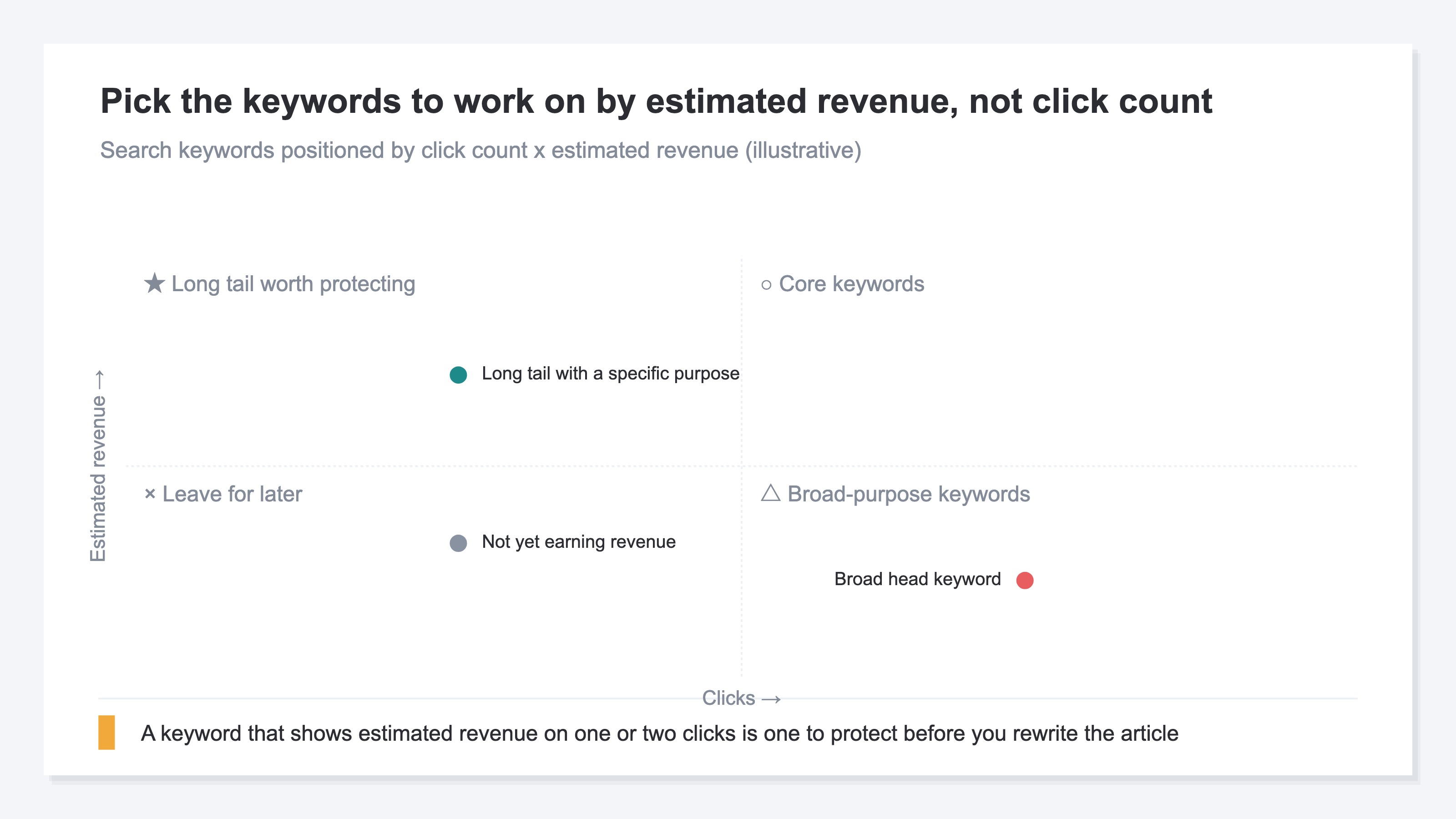
So multiply the average revenue per visitor arriving from search (RPS) by the click count, and you get a rough estimate of what that keyword earned. A keyword with one or two clicks still shows estimated revenue if it leads to purchases. Conversely, a keyword with plenty of clicks but a broad purpose may show estimated revenue that never grows.
Compare against the previous period on top of that, and the rising long-tail terms separate from the falling ones. A term that carries revenue and has started to slip is something to protect before you rewrite the article. The reason this does not end at "just look through the queries in GSC yourself" is that GSC's raw screen does not connect queries to revenue, so it cannot select the terms worth protecting by revenue.
RevenueScope solution
RevenueScope displays clicks and estimated revenue for each search keyword on one screen. Estimated revenue is an approximation: the average revenue per visitor arriving from search (RPS) multiplied by that keyword's click count. A comparison against the previous period comes with it, so you can tell whether the long-tail terms carrying revenue are rising or slipping. The table below is an image of how that looks.
| Search query | Clicks | Estimated revenue | Vs. prior period |
|---|---|---|---|
| 敏感肌 化粧水 かゆくなる (toner for sensitive skin, makes it itch) | 2 | ¥8,400 | +18% |
| 40代 くすみ 美容液 口コミ (serum for dullness in one's 40s, reviews) | 1 | ¥6,200 | +9% |
| 化粧水 詰め替え コスパ (toner refill, value for money) | 2 | ¥5,100 | -12% |
| 化粧水 (toner) | 34 | ¥3,700 | +2% |
This zero-volume long-tail query comparison is illustrative. A display sample built on a fictional site with sample data. The store is Japanese, so the search queries stay in Japanese, with an English gloss added in parentheses. Estimated revenue is a conservative approximation (biased low), not a settled revenue figure. GSC covers Google search only, and its aggregation runs a couple of days behind.
In this example the high-volume keyword (化粧水, toner) brings plenty of clicks, but its purpose is broad and its estimated revenue is not large. The long-tail terms with one or two clicks, meanwhile, show estimated revenue when the purpose behind them is clear, and the comparison against the prior period separates the rising from the slipping. Because GSC's screen alone does not produce this estimated revenue column or this prior-period column, it cannot select which long-tail terms to protect by revenue. RevenueScope puts clicks, estimated revenue and the prior-period comparison for each search keyword on one screen, giving you the basis to choose the long-tail terms worth protecting by revenue.
FAQ#
Frequently asked questions#
Q. Is there any point working on a keyword with zero search volume?
A. Yes. Its search count is simply too small to be measured, and clicks are still happening. Keywords like these come in such variety that gathered together they can account for around half of all search clicks. Judge by how many clicks the total produces, not by the search count of any one word.
Q. Where should the line between long tail and head be drawn?
A. There is no strict rule. This article treats two clicks or fewer over 90 days as long-tail, but you are free to set it to fit the size of your site. What matters is deciding where the line sits first, then reading the totals for clicks and revenue.
Q. Which long-tail terms should I start with?
A. Choose by estimated revenue and the change vs. the prior period, not by click count. A long-tail term that earns revenue and has started to slip is something to protect before you rewrite the article. Keywords that have yet to tie to revenue can wait.
Q. How do I find keywords that don't appear in search volume tools?
A. From the record of clicks that actually arrived from search. Google Search Console records keywords as search terms even when their search counts are never measured. Tools that estimate volume only look at the measurable keywords at the top, so the two serve different roles.
Summary#
A keyword that Keyword Planner reports as zero search volume is not necessarily worth zero. Its search count is simply too small to be measured, and keywords like these come in such variety that gathered together they account for around half of all search clicks. Over 90 days on our own site, 79% of the keywords that received clicks were long-tail, and they carried 52% of all clicks.
What matters is reading how many clicks and how much revenue the total produces, rather than the search count of any single word. On that footing, pick the terms to work on and the terms to protect by estimated revenue and the prior-period comparison, not by click count. Before you write off a zero-volume keyword, check whether that keyword is in fact producing clicks and revenue.
See which ads actually drive revenue, at a glance
Free up to 5,000 sessions/month, AI analyst included. No credit card required. Up and running in 5 minutes.