
You asked ChatGPT about your own store, and the opening hours and the shipping terms both came back out of date. Wanting to correct it is one thing. The correction has more than one place to go, and there is no time to touch all of them. This article goes as far as deciding where to start — not on instinct, but on where visits actually landed.
Contents
TL;DR#
- The details ChatGPT returns about a store come from three sources, and the only one an operator can reach is their own site
- The crawler that puts you in the search surface and the crawler used for training are specified separately[1]
- What you can fix comes in three kinds: the body copy, structured data, and profile listings
- After an update, a recrawl can take days to weeks, so a lag sits between the fix and the answer[2]
- The order you fix them in is settled by which pages people are reaching through AI
1. Which of the Three Sources It Came From#
The same "old information" splits into three origins. Whether it can be fixed at all is set by which of the three it came from.
What this article covers is not how many tries it takes before your store gets named, and not whether the revenue figures an AI reports are correct. It is where the correction has to go once you have found the error. For the first, see checking whether ChatGPT names your brand; for the second, why AI gets numbers wrong.
The first source is your own site, read on the spot. An AI assistant sometimes goes and fetches a site while it assembles an answer. OpenAI separates the crawler that puts you in the search surface from the crawler used for training[1]. Appearing in the search surface requires allowing OAI-SearchBot access, and exclusion from training is specified on the GPTBot side instead[1]. The path that reads you and the path that takes you in are separate settings.
The second source is memory from an earlier training pass. Whatever was written at the moment it was taken in stays there as it was. The third is what other sites say. Round-up comparisons, reviews, a press release from a few years back. None of it was written by you, and all of it gets pulled as information about you.
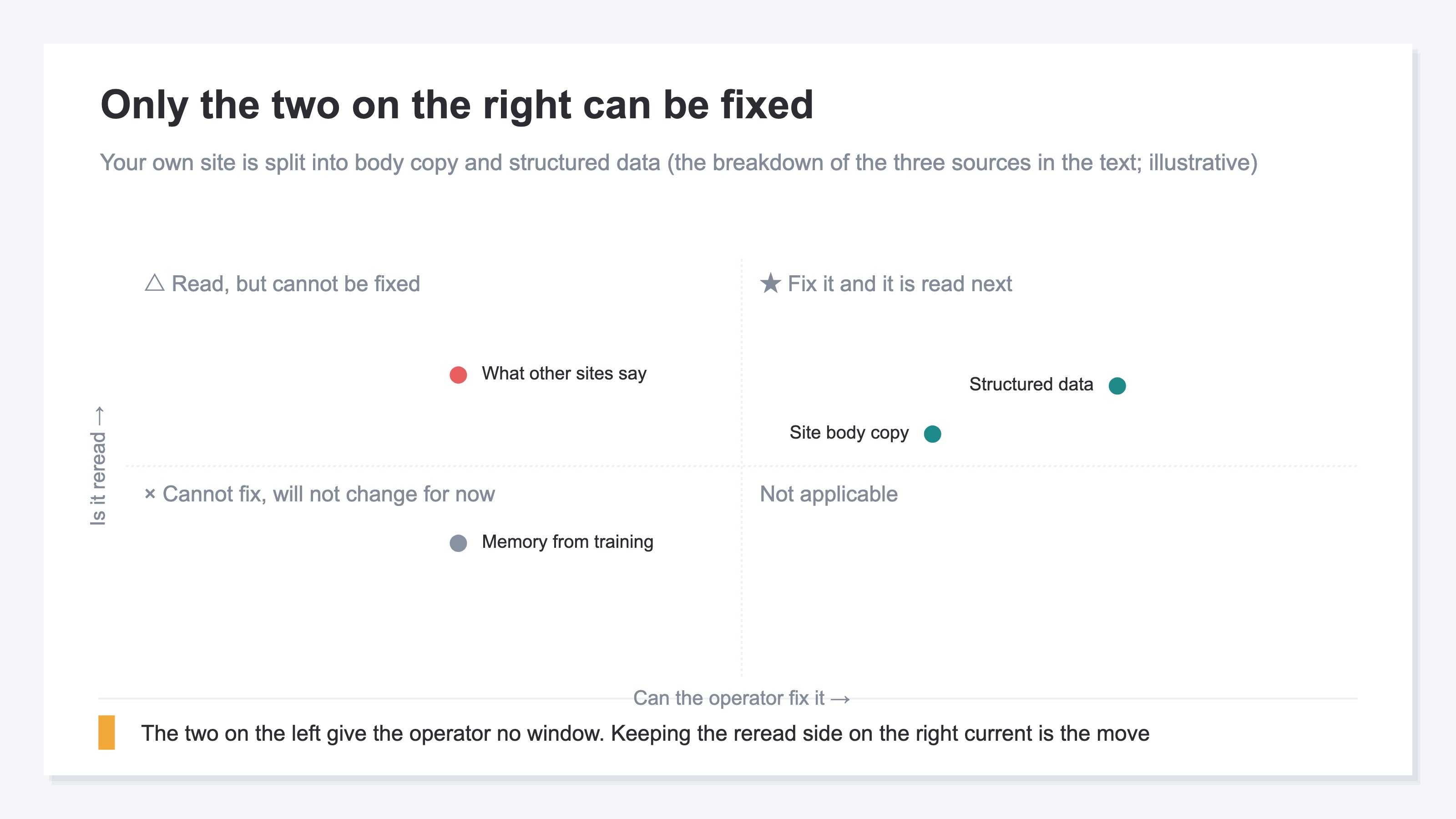
It is worth pinning down the wording here. Say "fix the information in ChatGPT" and it sounds as though the thing being fixed sits inside ChatGPT. That is not what anyone can reach. What you can reach is the writing you keep on your own site, and the settings that govern the paths that come to read it. The destination of the verb "fix" is somewhere other than where it first appeared to be.
Which means the work itself is not a GEO-only exercise. It is keeping the writing on your own site current — the same groundwork SEO already runs on. What differs is what you look at afterwards to confirm it.
2. What You Can Fix, and How Long It Takes to Land#
There are three kinds of place you can fix. None of them takes effect the instant you update.
The first is the body copy on your own site. Opening hours, the shipping notice, how stock is handled, whether you carry an item at all. Those four are roughly what matters right before a purchase. Whether the reader is a person or an AI, it is the same writing that gets read.
The second is structured data, where you restate the information in a form machines read. Opening hours and the address of a physical store can go into LocalBusiness structured data[3]. A product's price and availability can go into Product structured data[4]. Information that is hard to read out of prose alone, because the wording varies, gets handed over in a fixed shape.
The third is profile listings. If you have a physical store, the business information on your Google Business Profile is yours to edit[5].
Then comes the lag. Google writes that crawling "can take anywhere from a few days to a few weeks"[2]. The window for requesting a recrawl sits in Google Search Console. That only lets you ask, though — it fixes no date for when the change shows up. The range on the AI side, for how long until it reads a page again, is not published.
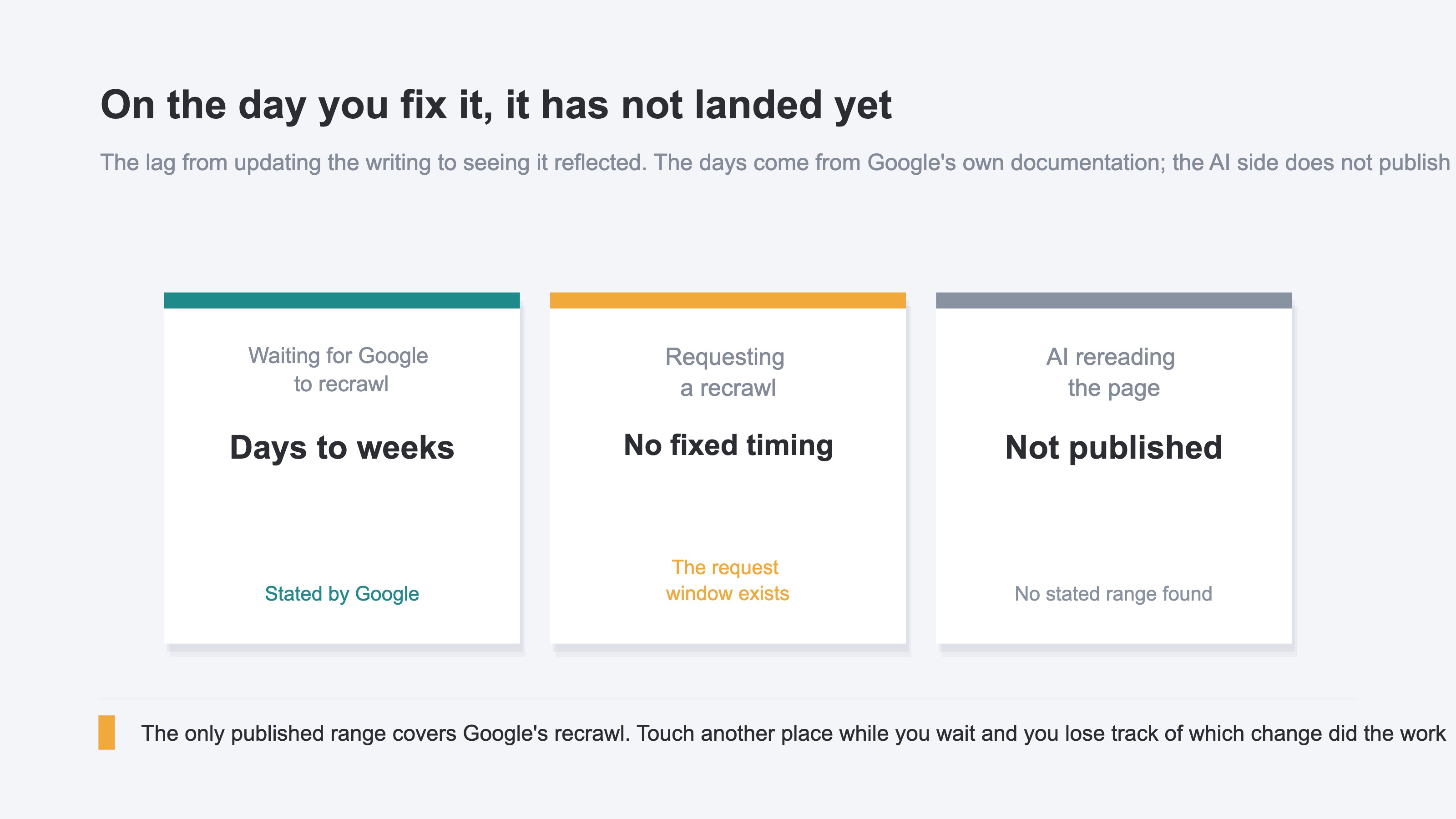
Because of that lag, checking on the day you made the fix and finding nothing changed is the normal outcome. Touch another place out of impatience and you lose track of which change did the work. For the side of this that is about getting read at all, see the base that gets you into ChatGPT's answers.
The problem is that there is no time to work through all three kinds. With 200 product pages, redoing the structured data alone burns days. Start without settling an order and, by the time one part is current, another entry has gone stale.
3. What Works Instead Where You Can't Fix It#
Memory from an earlier training pass, and stale entries on other sites. For these two, no window is provided for an operator to rewrite them directly.
As far as I could confirm, no window is published for an operator to rewrite existing memory. That is a statement about the absence of a window, not a claim that the content never changes. Even so, you cannot build a plan on waiting for it to be fixed there.
What works instead is thickening the side that gets reread on the spot. When there is writing available to read while an answer is being assembled, an AI can use it. The more current the writing on your own site is, the less room there is to fall back on old memory. That way of working is covered in making the AI you already use smarter with your own numbers. How entries on other sites weigh in is covered in what makes AI pick a store.
One thing to say plainly. Nobody can promise that fixing it makes the answer come back that way. What an AI answers is not something an operator controls. So the confirmation is not rereading the wording of the answer. It is whether anyone reached that page through AI.
AI-referred arrivals are identified from referrer information and from how the visit identifies itself. Not every AI assistant passes a referrer, so this figure is a floor on the number of arrivals that actually came through AI. Exposure that was cited but never turned into a click is not in here either. Even so, the order of which pages people reached, within what can be observed, is visible in this figure.
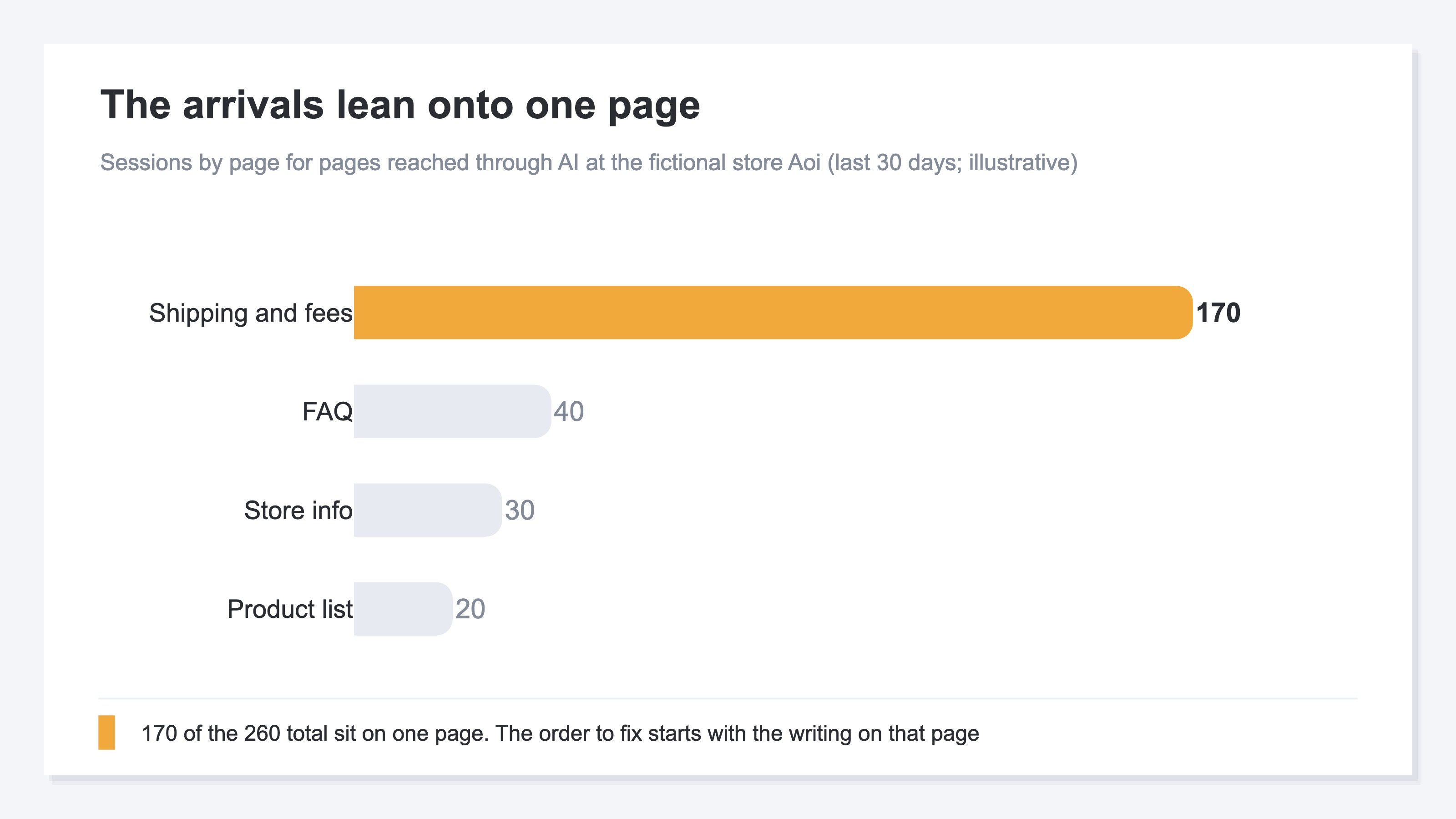
The list of candidates to fix sits on your own site. Where people are arriving sits on the AI-referred side. The two live in separate places, and no screen puts them in the same order. What is missing is not new data — it is something that puts those two into one ordering.
RevenueScope solution
RevenueScope displays sessions that arrived by click from an AI answer, as combinations of landing page and AI entry point. Each row shows sessions, the revenue for those landing sessions, and the last date an AI-referred arrival occurred. Google Search Console is a window onto Google search only, so this per-entry-point list does not come out of it.
Ask an AI assistant such as ChatGPT over MCP, "Which pages had AI-referred arrivals in the last 30 days?", and it comes back in the following form. Written out here with the fictional store Aoi for the sake of explanation.
| Landing page | AI entry point | Sessions | Revenue | Last arrival |
|---|---|---|---|---|
| Shipping and fees | ChatGPT | 120 | ¥180,000 | Aug 12 |
| Shipping and fees | Perplexity | 50 | ¥70,000 | Aug 11 |
| FAQ | ChatGPT | 40 | ¥30,000 | Aug 9 |
| Store info | ChatGPT | 30 | ¥10,000 | Aug 5 |
| Product list | Perplexity | 20 | ¥10,000 | Aug 3 |
Note: the table above is one example assembled for explanation at the fictional store Aoi (illustrative), with the figures rounded. What the screen behind the button aggregates is the sample store's sample data (refreshed daily), so the page names and the amounts shown there are different from the ones above.
The shipping and fees page alone accounts for 170 sessions. Add the other three pages together and you get 90. AI-referred arrivals are not spread thin — they lean onto one page. The order to fix starts with the writing on that page. The store info page, with its stale opening hours, sits at 30 sessions, and the grounds for leaving it until later hold within what can be observed.
On the same page, ChatGPT accounts for 120 and Perplexity for 50. A different entry point means a different answer to check next. The product list, whose last arrival stopped at Aug 3, has no arrivals to win back right now even if you fix it. With all of that on one screen, whether to touch the 200 product pages is settled today.
FAQ#
Frequently asked questions#
Q. Is there a window for asking ChatGPT to correct an error directly?
A. As far as I could confirm, no window is published for an operator to rewrite existing memory. What you can reach is the writing on your own site, the side that gets read on the spot. The crawler that puts you in the search surface and the crawler used for training are specified separately[1].
Q. If I fix my own site, will ChatGPT's answer become current?
A. Nobody can promise that. What the answer contains is not something an operator controls. Take the confirmation from whether the page received AI-referred arrivals, not from the wording of the answer.
Q. If I add structured data, will the shipping terms be conveyed too?
A. What goes into Product structured data is price and availability[4]. How shipping is handled is something this article was not able to confirm, so keeping the shipping notice current in the body copy is the reliable route.
Q. How long should I wait after making the fix?
A. Google writes that crawling can take anywhere from a few days to a few weeks[2]. The range on the AI side, for how long until it reads a page again, is not published. While you wait, the practical thing to watch is whether that page is receiving AI-referred arrivals.
Summary#
When ChatGPT returns stale details about a store, the origin splits three ways: your own site read on the spot, memory from an earlier training pass, and what other sites say. Only the first is within an operator's reach. The order runs not "fix what is inside ChatGPT" but "fix the place ChatGPT comes to read."
What you can fix comes in three kinds: the body copy, structured data, and profile listings. Opening hours and the address go into LocalBusiness[3], price and availability into Product[4]. Because a recrawl takes days to weeks after an update[2], checking on the day you made the fix and finding nothing changed is the normal outcome.
There is no time to fix all of it. So settle the order not by which stale line bothers you most, but by which pages people are reaching through AI. If the arrivals lean onto one page, the writing on that one page is where the fixing starts. The moment the order is settled, today's work narrows to one thing.
See which ads actually drive revenue, at a glance
Free up to 2,000 sessions/month, AI connection included. No credit card required. Up and running in 5 minutes.
References#
- [1] OpenAI Help Center "Publishers and Developers - FAQ" (2026)
- [2] Google Search Central "Ask Google to Recrawl Your Website" (2026)
- [3] Google Search Central "Local Business (LocalBusiness) Structured Data" (2026)
- [4] Google Search Central "Intro to Product Structured Data on Google" (2026)
- [5] Google Business Profile Help "Edit your Business Profile" (2026)

![[Research] What Makes AI Recommend Your Site: It Comes Down to Reviews and Reputation](/_next/image?url=%2Fimages%2Fnews%2Fhow-ai-picks-stores.jpg&w=3840&q=75)
![[Research] Does ChatGPT Name Your Brand? The Answer Changes Every Time](/_next/image?url=%2Fimages%2Fnews%2Fchatgpt-brand-check-single-try.jpg&w=3840&q=75)