"Can Triple Whale work for a Japanese ecommerce brand? How is it different from RevenueScope?" These are the two questions we hear most often from operators. The short answer: the two tools live in deliberately different scope zones — they're complements far more than competitors. Triple Whale is a full-feature ecommerce intelligence platform adopted by 60,000+ brands worldwide [1]; RevenueScope is a Japan-SMB-focused analytics tool that intentionally narrows its surface to a core 4 metrics (Revenue, AOV, RPS, CVR) plus Sessions as a 5-card dashboard. This article lines up the two tools across seven axes using May 2026 official data, then offers a four-criterion decision framework for operators choosing between them.
TL;DR#
- Triple Whale uses GMV-tiered pricing — Free / Starter / Advanced / Custom monthly rates flex according to a 7-step trailing-12-month GMV slider (<$250K through $350M+) [2]. The platform tracks $55B+ in revenue across 60,000+ brands [1].
- RevenueScope is built for Japanese SMB EC and limits itself to core 4 metrics — Revenue, AOV, RPS, CVR — plus Sessions, displayed as five KPI cards. It installs through GTM in five minutes via dataLayer pickup, ships in Japanese, and runs on three fixed plans (¥2,980 / ¥9,800 / ¥29,800 / month).
- The seven axes (language, feature scope, technical needs, pricing, ad-API integration, supported platforms, Japan-market readiness) trace a clean split — pick Triple Whale when English-first teams need full-stack measurement, pick RevenueScope when Japanese-first teams want lean, opinionated weekly KPI rituals. Functional overlap is small; a few brands deliberately run them side by side.
1. Triple Whale — A Full-Feature Ecommerce Intelligence Platform#
Triple Whale (triplewhale.com) was founded in Israel in 2021. As of May 2026 the official site positions itself as follows [1]:
- Brand footprint: 60,000+ brands [1]
- Tracked revenue: $55B+ across the platform
- Tagline: "The complete intelligence platform for ecommerce — Measurement. Analytics. AI. Creative. Automation."
- Headline metric: "+42% new-customer revenue within 90 days of signup" (official marketing claim) [1]
Core capabilities [1]:
- Triple Pixel: cross-device / cross-platform identity resolution (included in every plan, including Free)
- Moby AI: assistant suite (chat, agents, forecasting, image and video generation)
- Compass: integrated MMM (marketing mix modeling), MTA (multi-touch attribution), and incrementality testing
- Sonar: enrichment automations and email/SMS flow strengthening (Sonar Send)
- Self-Serve Analytics: 75+ pre-built dashboards
- Data Platform: a unified data warehouse with SQL Editor (Advanced plan and above)
Reference customers span SMB to enterprise D2C — Marine Layer, Travelpro, Peloton, OUAI, Origin, True Classic, Milk Bar, and many more [1].
2. RevenueScope — Built for Japanese SMB EC, Anchored on Core 4 Metrics#
RevenueScope (revenuescope.jp) launched in April 2026 as a Japan-built ecommerce analytics tool. The design philosophy in one phrase: "revenue-first analytics" — read the same data backwards from sales rather than forwards from traffic, positioned as a complement to GA4.
- Target: Japanese SMB ecommerce stores (¥10M-¥50M monthly revenue) running on Shopify, BASE, STORES, EC-CUBE, and similar platforms
- Core metrics: Revenue, AOV (Average Order Value), RPS (Revenue Per Session), CVR — the core 4 metrics — plus Sessions, surfaced as five KPI cards
- Installation: a single GTM tag in under five minutes; if GA4 ecommerce is already configured, no extra setup is required
- Language: full Japanese UI (English version also available), email support in Japanese
Why RPS Sits at the Top of the Hierarchy#
Among the core 4, RevenueScope treats RPS (Revenue Per Session = Revenue ÷ Sessions) as the single most important metric. RPS is the multiplicative product of acquisition efficiency and basket size, so a single number tells you whether your marketing is healthy. If traffic grows but RPS falls, acquisition quality is degrading; if CVR rises but RPS stagnates, you are leaving high-AOV buyers on the table. AOV and CVR are diagnostic levers used to investigate the cause; what you watch every day should be exactly one number, and that constraint is the realistic answer to dashboard fatigue. Full mechanics are covered in The RPS (Revenue Per Session) Formula and Worked Examples.
The design center of gravity is "rewriting the GA4 traffic-first report as a revenue-first one." For the dashboard architecture that follows, see The Right Way to Design a Revenue Dashboard.
3. The 7-Axis Comparison — What Actually Differs#
Lined up across seven axes, the split becomes hard to miss. Pricing data was checked live on the official sites on May 4, 2026 [2][3].

| Axis | Triple Whale | RevenueScope |
|---|---|---|
| 1. Language / support | English only; live chat / email on US business hours | Native Japanese UI; email support in Japanese |
| 2. Feature scope | Full-stack (Triple Pixel / Moby AI / Compass: MMM, MTA / Sonar / SQL Editor / 75+ dashboards) | Core 4 metrics (Revenue / AOV / RPS / CVR) + Sessions as a 5-card dashboard + channel-level revenue breakdown |
| 3. Technical needs | Base setup in 15 minutes, no engineer required (official) [1]; SQL Editor / MMM / Pixel deep customization assume engineering capacity | GTM install in five minutes via dataLayer; no engineer required |
| 4. Pricing range | GMV-tiered (detailed below). At the <$250K tier: Free / $149 / $219 (annual contracts) | ¥2,980 / ¥9,800 / ¥29,800 monthly — three fixed plans |
| 5. Ad-API integration | 60+ direct integrations (Meta, Google, TikTok, etc.); ad-spend ROAS calculation included | dataLayer + GA4 pickup (channel-agnostic). Ad-spend ROAS calculation is intentionally out of scope (delegated to GA4 / ad-platform consoles) |
| 6. Supported platforms | Shopify-centric (D2C-first feature design), Amazon integration, 60+ ecommerce integrations | Shopify / BASE / STORES / EC-CUBE — primary Japanese SMB EC platforms |
| 7. Japan-market readiness | English-only UI / USD-denominated pricing / no Japanese support / no Japan office / no Japanese landing page (verified May 2026 from public sources) [7][8] | Native Japanese UI / JPY-denominated pricing / explicitly designed for Japanese SMB EC |
To unpack the feature-scope difference: Triple Whale provides full-feature coverage anchored on direct ad-API integration. Spend data is pulled directly from Meta Ads, Google Ads, TikTok Ads, and others, and Triple Pixel performs cross-device identity resolution to answer "who, from which ad, bought how much" on a unified surface. MMM, MTA, and incrementality testing — three modeling approaches — are bundled under the Compass label, covering high-end advertising-effectiveness scenarios including ad-spend ROAS calculation.
RevenueScope is a dataLayer-piggyback design that simply reuses the existing GA4 ecommerce setup. There is no direct ad-API integration; the system aggregates revenue by channel from UTM parameters and dataLayer purchase events. Ad-spend ROAS calculation — which can already be obtained from the ad-platform console — is intentionally left out of scope, and the channel-level investment decision is taken from the movement of RPS / AOV / CVR on the purchase-event side. The smaller surface translates into less operational friction, and into cleaner adaptability when ad channels are added or removed.
A note on the Japan-readiness axis: as of May 2026 we could not verify a Japanese landing page, JPY-denominated pricing, or a Japan office for Triple Whale from public sources, so the practical experience for a Japanese operator remains an English UI plus USD-denominated pricing. Shopify's store currency setting can render JPY in the storefront, but the Triple Whale UI, support channels, and pricing themselves stay English / USD by default [7][8].
3.x This Is About Deliberate Scope Design, Not Superiority#
The comparison above is not a verdict on which tool is "better" — it's a comparison of deliberate scope decisions. Triple Whale, true to its "ecommerce intelligence platform" framing, aims for comprehensive coverage: ad efficiency (MMM / MTA / incrementality), inventory, subscriptions, and creative analytics all sit inside the same product. RevenueScope, true to "revenue-first analytics," intentionally narrows scope to the core 4 metrics (Revenue, AOV, RPS, CVR) plus Sessions as a 5-card dashboard, and deliberately excludes work that the ad-platform console already does well — including ad-spend ROAS. Narrow scope minimizes operational load and removes ambiguity from the weekly dashboard ritual; that's the optimization for Japanese SMB EC. Deciding what not to measure turns out to be the design judgment that keeps a dashboard in active use.
4. Pricing Architecture — GMV-Tiered for Triple Whale, Fixed Three-Tier for RevenueScope#
Side-by-side monthly comparisons can mislead because the two pricing models differ structurally. We separate them out here.
4.1 Triple Whale — GMV-Tiered#
Triple Whale's price is set by the combination of "trailing-12-month GMV" and "selected plan" [2][3]. The GMV slider has seven steps, and Free / Starter / Advanced / Custom flex per step:

GMV tiers: <$250K → $5M → $15M → $40M → $100M → $175M → $350M+
At the lowest tier (annual revenue <$250K), the May 4 2026 monthly rates were as follows. Annual contracts (12-month commit, two months discounted) and month-to-month differ:
| Plan | Monthly (annual) | Monthly (m2m) | Headline features |
|---|---|---|---|
| Free | $0 | $0 | Triple Pixel / First/Last-Click Attribution / 10 stores / 10 users / Moby Chat / AI Visibility for ChatGPT |
| Starter | $149 | $179 | + Multi-Touch Attribution / Sonar Send / Influencer Analytics / Custom Metric Builder / Unlimited Lookback |
| Advanced | $219 | $259 | + Subscription Data / Total Impact Attribution / Creative & Product Analytics / SQL Editor / All UAs (Gemini, Claude, etc.) |
| Custom | (request quote) | $539+ | White-Glove Migration / SLA / Dedicated Success Team |
Because monthly pricing scales with GMV across the same plan, mid-market D2C brands at the $5M-$15M tier on Starter / Advanced typically end up in the several-hundred to low-four-figure dollar range per month. Walk the GMV slider on the official Pricing page to see your own tier [2][3].
The notable design choice: Free already includes Triple Pixel and First/Last-Click Attribution. "AI Visibility for ChatGPT" — the official feature label, which surfaces brand mentions, citations, and sentiment inside ChatGPT — is on the Free plan as well, signaling Triple Whale's deliberate positioning for the AI-search era [2].
4.2 RevenueScope — Three Fixed Plans#
RevenueScope pricing is decoupled from GMV. Three fixed plans differentiated by site count and monthly session volume:
| Plan | Monthly | Sessions/month | Sites | Data retention |
|---|---|---|---|---|
| Starter | ¥2,980 | 10K | 1 | 14 months |
| Growth | ¥9,800 | 50K | 5 | 24 months |
| Scale | ¥29,800 | 200K | 10 | 36 months |
All plans include unlimited team members, Japanese-language support, and coverage for Shopify / BASE / STORES / EC-CUBE — the dominant Japanese SMB EC platforms. Pricing details: pricing page.
4.3 What "Cheap vs. Expensive" Hides#
A flat "monthly fee" comparison misleads. Triple Whale's $149/month Starter is the <$250K-GMV-tier rate; it climbs as GMV grows. RevenueScope's tiers are session-volume-based, so they reward high-AOV / low-volume stores and look less efficient relative to Triple Whale for high-volume / low-AOV subscription D2C, where the wider feature set tends to earn its keep.
The right framing is the three-axis lens — own GMV × brand archetype × feature requirements — and asking which tool covers what you actually need at the lowest total cost.
5. Four Decision Criteria — Which One Fits#
Four binary axes resolve most decisions cleanly:

| # | Criterion | Triple Whale fits when... | RevenueScope fits when... |
|---|---|---|---|
| 1 | Language | Core team operates in English; expansion is US/EU | Japanese is required; the team is fully Japanese-speaking |
| 2 | Feature depth | You need MMM / MTA / subscriptions / SQL / margin / inventory / ad-spend ROAS in one place | The core 4 metrics (Revenue, AOV, RPS, CVR) plus Sessions are enough |
| 3 | Engineering | You can leverage advanced features — SQL, custom Pixel, MMM | No dedicated engineer; you want to operate inside GTM |
| 4 | Ad-API integration | You need 60+ direct ad-API integrations and ad-spend ROAS in-app | UTM + dataLayer purchase aggregation is enough; ad-spend ROAS lives on the ad-platform console |
5.1 "English-first + engineers + full feature stack" → Triple Whale#
Triple Whale is the platform that bundles everything serious D2C operations need into one stack. Engineering teams that can split work across Compass MMM / MTA, customize Triple Pixel for stronger identity resolution, and build their own dashboards in SQL Editor will pay back the several-hundred to low-four-figure monthly investment.
5.2 "Japanese-first + lean operations" → RevenueScope#
When the operating team works in Japanese and the weekly ritual is "look at four metrics, decide where the next ad budget goes," a full-feature platform is overkill. More settings means more operational load means more "dashboard graveyards." RevenueScope's core 4 metrics + Sessions = 5 KPI cards ceiling is a deliberate constraint, and "removing things to choose between" is the value proposition.
6. Where RevenueScope Genuinely Fits#
To make the decision concrete, here is the persona we built RevenueScope around.
6.1 Core Persona#
- ¥10M-¥50M monthly revenue Shopify / BASE / STORES / EC-CUBE operators
- 1-3 marketers; no dedicated engineer
- GA4 ecommerce already configured; comfortable with GTM
- Wants weekly dashboard reviews in Japanese
- Decides ad-spend ROAS using GA4 / ad-platform consoles, and uses RevenueScope to read RPS / AOV / CVR shifts for channel investment decisions
6.2 Reinforcement Lenses — Data Ownership and Onboarding Time#
Two angles that comparison articles often skip, surfaced from our CSO process:
Data ownership / data residency
Triple Whale stores customer data in US data centers. For Japanese ecommerce operators, this raises a documentable obligation under the revised Telecommunications Business Act ("external transmission rules") [4] and the Personal Information Protection Act [5] — namely, "to what extent can we explain ourselves as the controller of personal-related information." RevenueScope runs production on Supabase's Northeast Asia (Tokyo) region, designed from day one for Japanese regulatory compliance. When dual GDPR / revised Telecommunications Business Act compliance matters, "data residency you can explain in writing" becomes a real evaluation criterion.
Onboarding time / learning cost
Setup itself is fast for both (Triple Whale 15 minutes, RevenueScope 5 minutes). But "time to fluently using the dashboard" is a separate axis. Triple Whale has many features; comprehending Moby AI / Compass / Pixel / Sonar / SQL Editor and stitching an operating workflow takes real ramp time. RevenueScope is fixed at the core 4 metrics + Sessions = 5 KPI cards, so the operating mental model becomes legible quickly, and the diffusion of adoption across the team meets less friction. The hidden decision criterion among "branded comparison searchers" is actually "days to first useful insight", and Japanese SMB EC is exactly where that metric works in RevenueScope's favor.
6.3 The Kinds of Questions RevenueScope Answers#
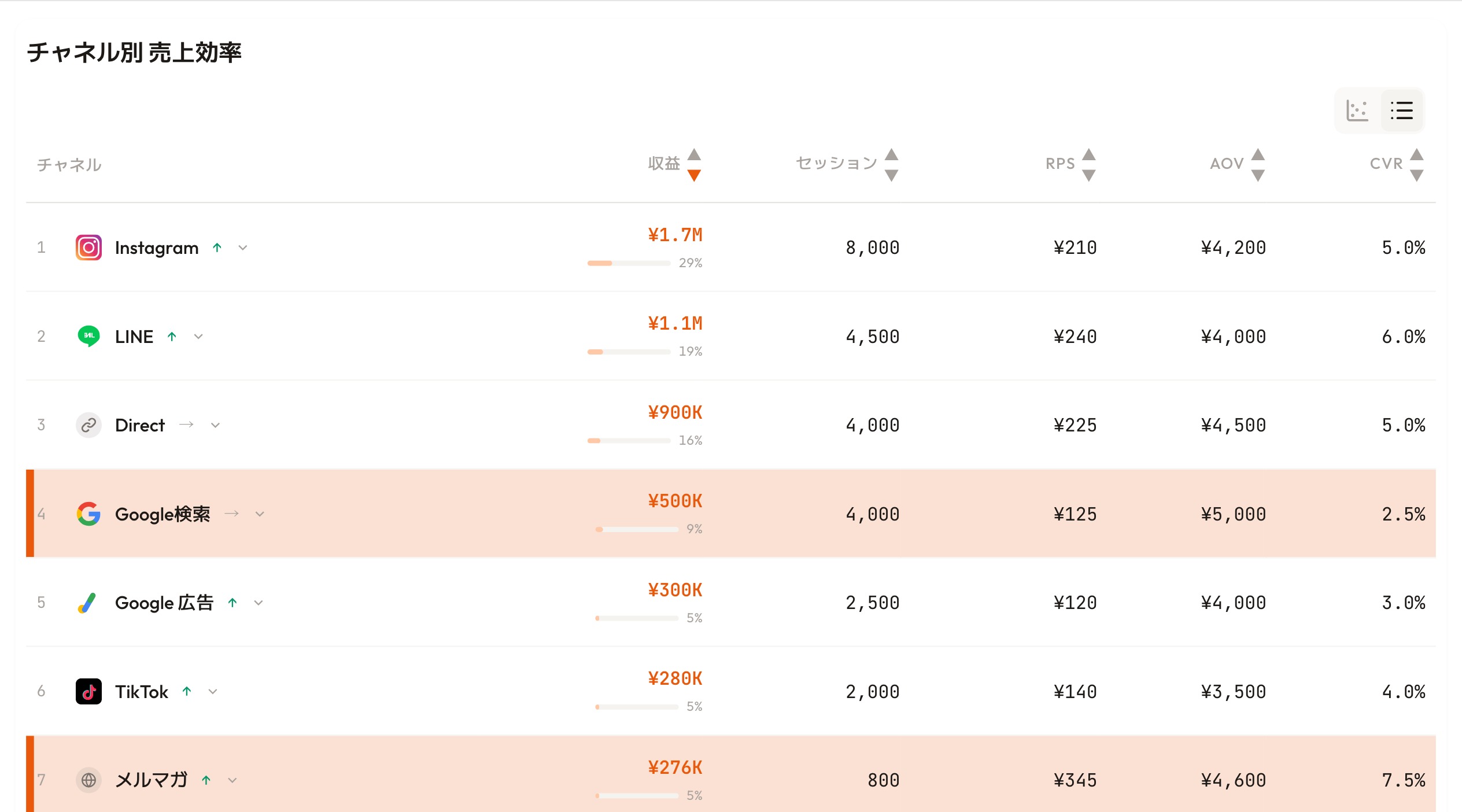
- "Meta-acquired sessions show RPS of ¥150; Google search ads show RPS of ¥450 — shift more of next month's budget toward Google."
- Auto-normalize UTM-parameter inconsistencies (facebook / Facebook / fb / meta) and compute channel-level revenue cleanly.
- Compare your own RPS against the industry-median RPS to read your relative position (see Industry RPS Benchmarks).
- Even when an ad-API outage or a temporary suspension happens, the purchase-event-side RPS / AOV / CVR continue uninterrupted, so the channel-investment decision baseline doesn't break.
Triple Whale can solve all of these too — but RevenueScope's purpose-built design for Japanese SMB EC operations makes it the lower-friction option for that specific persona.
Summary#
- Triple Whale is a 60,000+ brand-strong full-feature ecommerce intelligence platform with GMV-tiered Free-through-Custom plans
- RevenueScope is a Japanese-SMB-EC tool focused on the core 4 metrics (Revenue, AOV, RPS, CVR) + Sessions = 5 KPI cards, installed via GTM in five minutes, three fixed plans, full Japanese UI
- The relationship is complementary scope, not competitive overlap. English + full feature stack + engineers → Triple Whale. Japanese + lean operations + no engineers → RevenueScope.
- Add data residency (Tokyo region) and post-onboarding learning curve to the decision matrix, and pick the one that fits your team profile, market strategy, and operating maturity.
"Triple Whale's feature set is impressive, but the English UI and US data centers won't land with the ops team," or "we'd rather start with a Japanese tool that runs the core 4 metrics cleanly" — for those operators, RevenueScope is the lower-friction entry point. For "we're operating globally and want Meta / Google / TikTok ad-API integration plus ad-spend ROAS in one place," Triple Whale is the better fit.
Some brands deliberately run both — RevenueScope for the daily Japan-market view, Triple Whale for the quarterly global MMM analysis — and the design that makes that easy is precisely the lack of feature overlap.
Next: a TCO comparison of "self-built analytics vs. RevenueScope" — GA4 + BigQuery + Looker Studio versus RevenueScope, with build / operate / improve hours laid out by monthly-revenue tier with concrete numbers.
References#
[1] Triple Whale. "Triple Whale Homepage — Ecommerce Intelligence Platform." Accessed May 4, 2026. https://www.triplewhale.com/
[2] Triple Whale. "Triple Whale Pricing — Plans and Tiers." Accessed May 4, 2026. https://www.triplewhale.com/pricing
[3] Triple Whale. "Triple Whale Pricing FAQ — How does pricing work / What happens if my revenue grows." Accessed May 4, 2026. https://www.triplewhale.com/pricing
[4] Ministry of Internal Affairs and Communications (Japan). "Revised Telecommunications Business Act — External Transmission Rules: Public Notices and Related Materials." Accessed May 5, 2026. https://www.soumu.go.jp/menu_news/s-news/01ryutsu02_02000408.html
[5] Personal Information Protection Commission (Japan). "Guidelines on the Act on the Protection of Personal Information (Acts and Guidelines)." Accessed May 5, 2026. https://www.ppc.go.jp/personalinfo/legal/
[7] Triple Whale. "Contact — English-only support channels and US/Israel office locations." Accessed May 5, 2026. https://www.triplewhale.com/contact
[8] Triple Whale. "About — Company overview (English UI / English documentation)." Accessed May 5, 2026. https://www.triplewhale.com/about
See which ads actually drive revenue, at a glance
14-day free trial. No credit card required. Up and running in 5 minutes.
Start 14-day free trial