"Should we adopt MMM (Marketing Mix Modeling) too?" "Do we need incrementality measurement at ¥50M monthly revenue?" Since the start of 2026, EC operators have been asking these questions in rapid succession. LinkedIn, X, and overseas SaaS vendor blogs are full of headlines like "2026 is the year of MMM revival," "AI changes measurement," and "Full Cookieless transition." Many SMB EC operators do not know where to start.
The short answer: the 2026 EC measurement landscape has 5 trends, but SMB ECs do not need to chase all of them. For mid-market ECs under ¥1B monthly revenue, MMM and incrementality measurement carry steep barriers in required data volume, talent skills, and initial investment, with ROI that rarely makes sense. On the other hand, Cookieless tracking and AI in analytics are worth pursuing regardless of scale. This article maps the 2026 EC measurement 5 trends to adoption layer, required resources, and SMB EC fit, and presents a positioning model by revenue range. We also disclose RevenueScope's honest stance on each trend from our 5-KPI focus philosophy.
Note on terminology: We use Revenue Per Session (RPS) below. RPS is not yet a standardized industry metric in the same way as ROAS or LTV — it is RevenueScope's core metric. We spell out the full term on first mention.
Table of contents
- The 5 Major Trends in 2026 EC Measurement
- ① MMM — Enterprise Mainstream Returns
- ② Incrementality Measurement — Proving Net Lift
- ③ AI in Analytics — Report Automation and Anomaly Detection
- ④ Profit-centric KPIs — Beyond ROAS Worship
- ⑤ Cookieless Measurement — Mandatory for All EC
- Trend Priority by Revenue Range — Position Diagnosis
TL;DR#
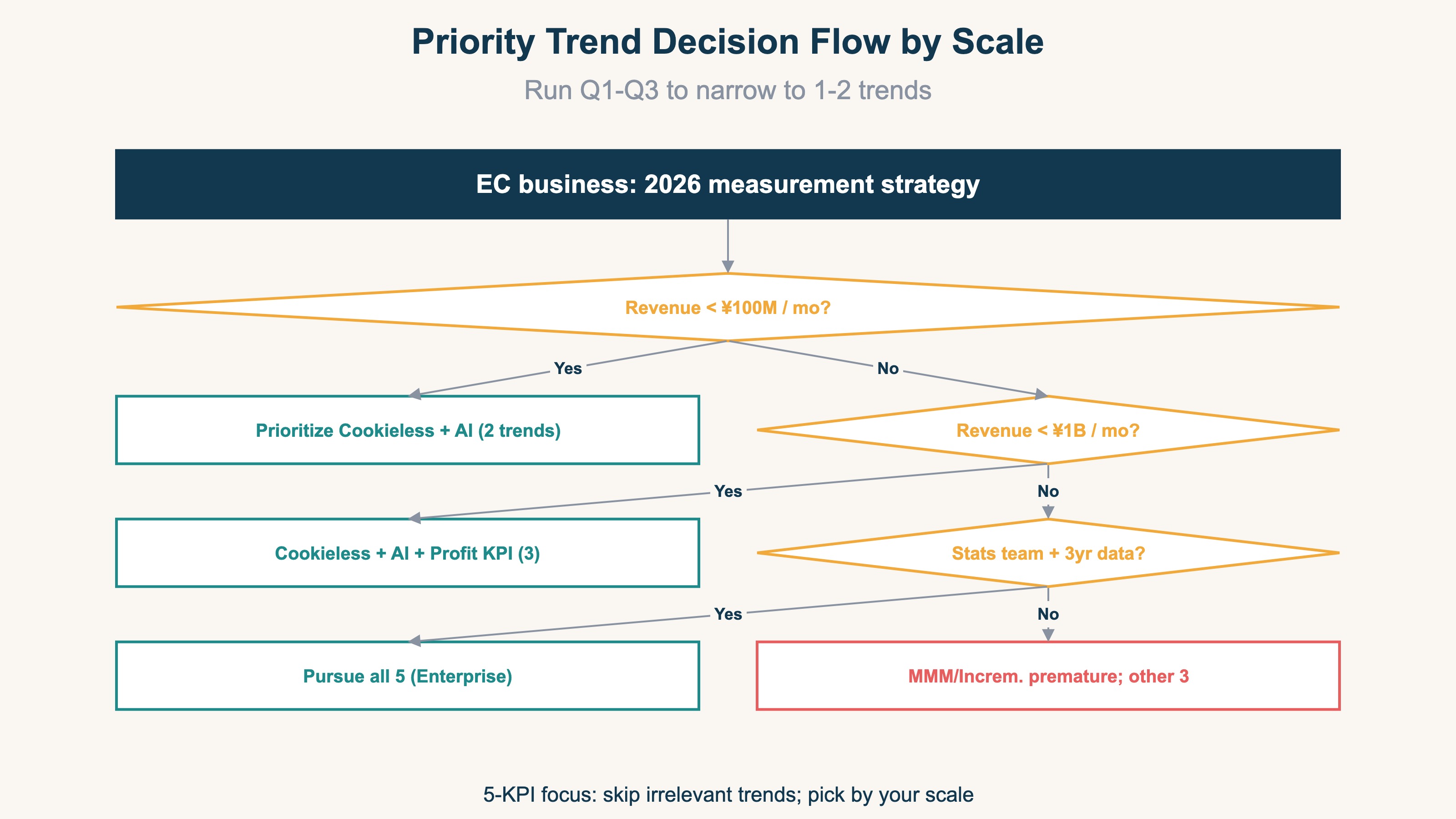
- The 2026 EC measurement landscape has 5 trends (① MMM ② Incrementality ③ AI in analytics ④ Profit-centric KPIs ⑤ Cookieless). Only enterprises with ¥1B+ monthly revenue should pursue all 5; SMB ECs should narrow to 1-2 by revenue range
- Priority by revenue range: under ¥10M/mo → Cookieless only; ¥10-50M → Cookieless + AI; ¥50-100M → add Profit-centric KPIs; ¥100M-1B → add Incrementality; ¥1B+ → all 5. Chasing every trend hurts ROI for SMB ECs
- RevenueScope's stance: From our 5-KPI focus philosophy, MMM and Profit-centric KPIs are not supported, Incrementality has an alternative (channel-level RPS diff), AI is partial (Q3 2026 roadmap), and Cookieless is standard (dataLayer + first-party cookies). Honest disclosure helps you decide whether RS fits
1. The 5 Major Trends in 2026 EC Measurement#
When you overlay overseas marketing tech industry signals with Japanese regulatory shifts, the 2026 EC measurement landscape converges on 5 trends. Adverity's "Marketing Predictions for 2026" (Dec 2025)[1], the release of Google Meridian (open-source MMM)[4], and updated Cookieless guidance from Japan's MIC and PPC together produce the map below.
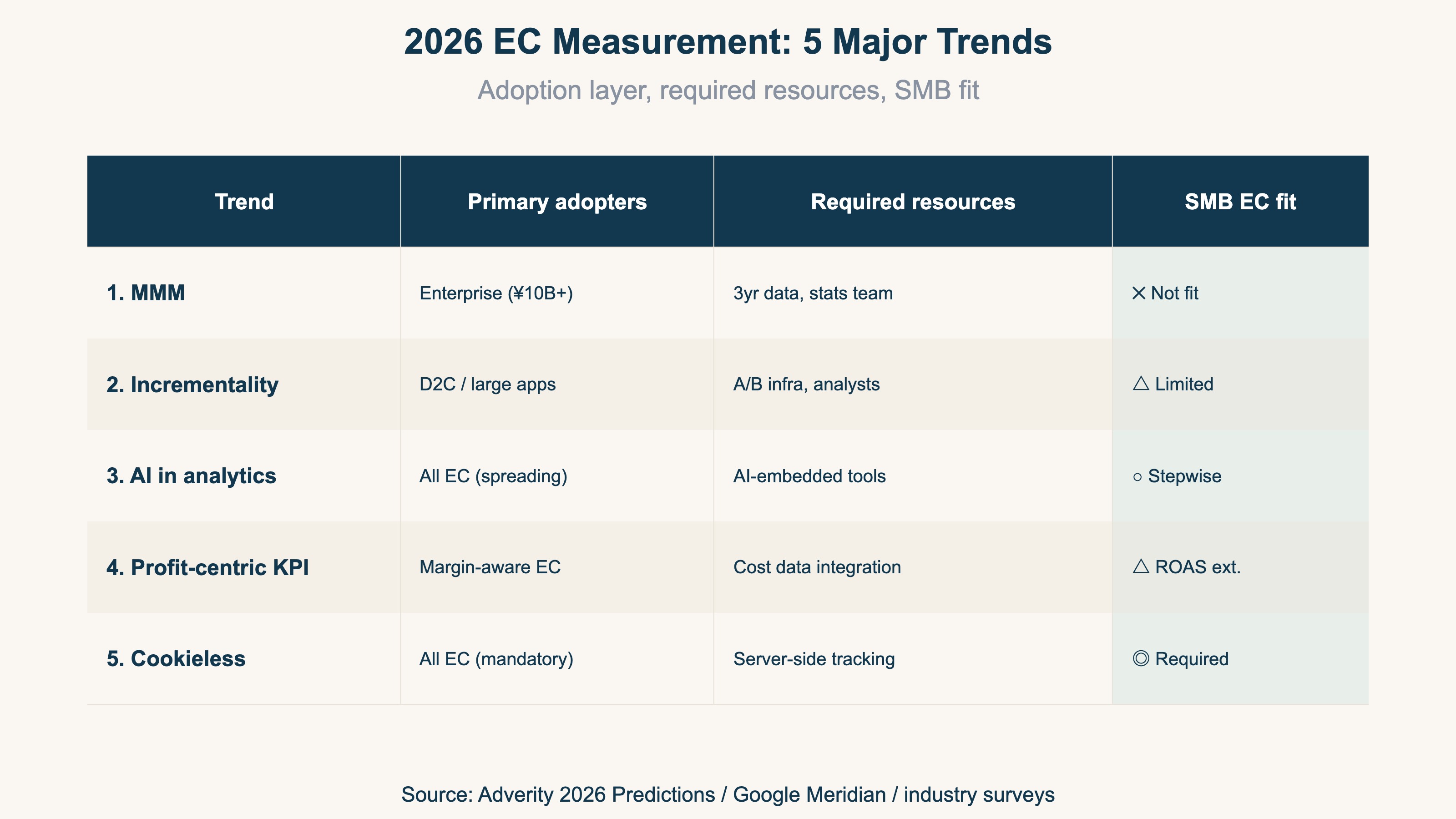
Only enterprises above ¥1B monthly revenue can honestly say they cover all 5. For SMB ECs under ¥100M, the strategic decision in 2026 is which 1-2 trends to focus on, not how to do everything.
2. ① MMM — Enterprise Mainstream Returns#
Marketing Mix Modeling estimates the contribution of each ad medium and promotion using statistical models. In the late 2010s, attribution was supposed to make MMM obsolete. But in the late 2020s, privacy crackdowns (iOS ATT, cookie restrictions) broke attribution measurement, and 2024-2026 has seen a clear return to MMM[3].
In 2024, Google open-sourced its internal MMM framework as Meridian[4]. Shopify and ASOS publish adoption case studies, and MMM is no longer the exclusive domain of Google, Meta, and stats consultancies.
But "the tool is accessible" is not the same as "you can adopt it." MMM requires:
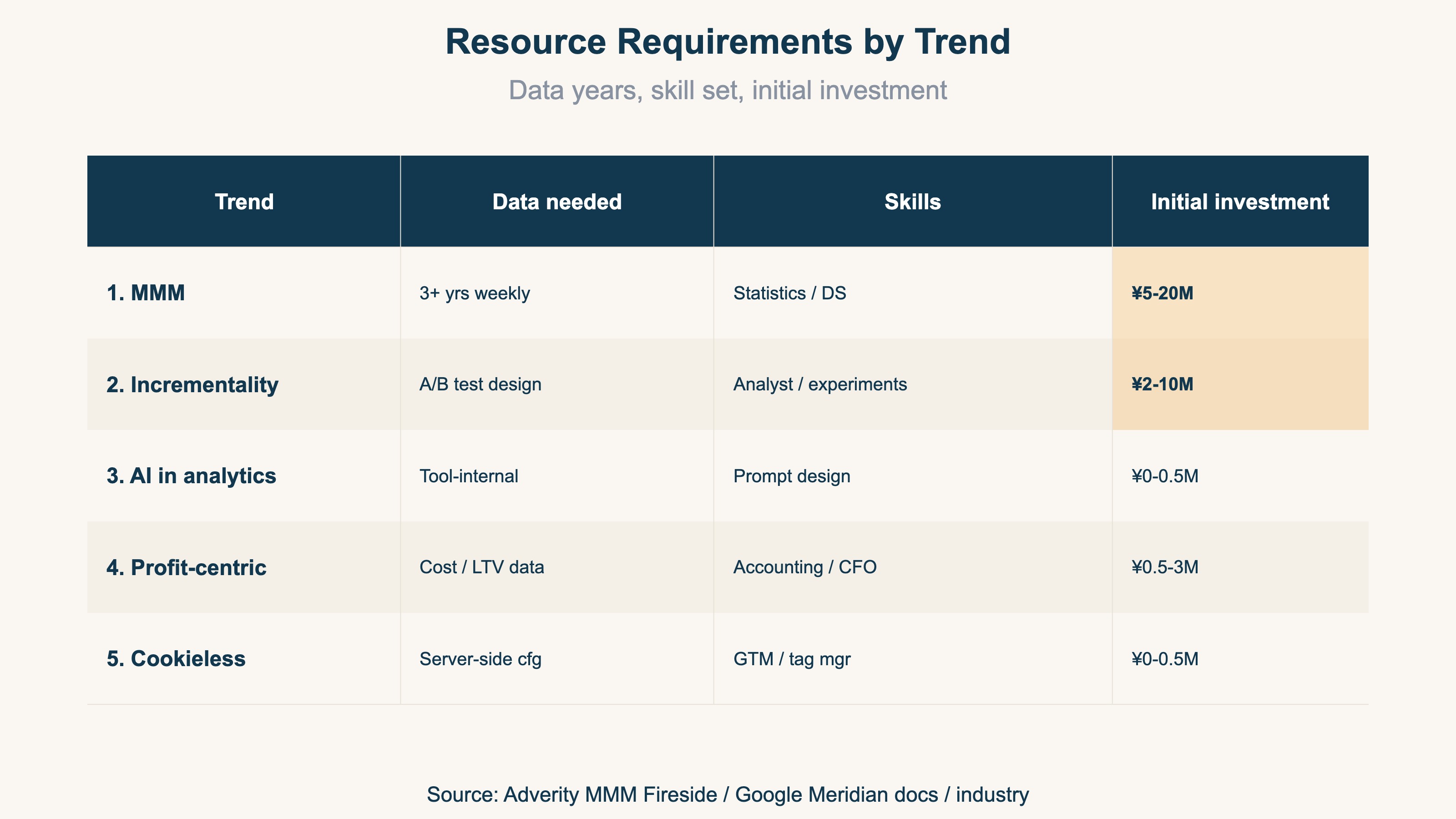
- Data: 3+ years at weekly granularity
- Talent: Dedicated statistics / data science staff
- Initial investment: ¥5M-¥20M (model build + tools + validation)
- Monthly ops: 20-40 hours
Most SMB ECs under ¥100M monthly revenue have never accumulated 3 years of weekly-granularity data. Many EC operators are less than 3 years old, with discontinuities in their data.
RevenueScope's stance: not supported. We deliberately omitted statistical model layers to optimize for "one tag, 5 minutes, GTM" onboarding for SMB ECs. ECs that have grown into MMM scale should look at Google Meridian, Adverity, Improvado, or full-stack EC analytics like Triple Whale.
3. ② Incrementality Measurement — Proving Net Lift#
Incrementality measurement quantifies the net lift from ad spend — the revenue that would not have happened without the ad. A/B tests, geo experiments (regional split tests), and holdout tests verify whether ROAS numbers are double-counting customers who would have bought anyway.
The push for incrementality in 2024-2026 stems from widespread recognition among brand advertisers that raw ROAS overstates ad effectiveness. Adverity's "MMM Fireside Chat with Labelium" (Feb 2025)[3] notes that the combination of incrementality and MMM is becoming the 2025-2026 standard for ad effectiveness measurement.
Required resources:
- Data: A/B test design (3-6 months minimum experiment period)
- Talent: Analyst / experiment designer (in-house or external)
- Initial investment: ¥2M-¥10M
- Monthly ops: 10-20 hours
RevenueScope's alternative: channel-level RPS diff. We do not have a dedicated incrementality module, but channel-level Revenue Per Session (RPS) differences serve as a proxy. If "ad-driven sessions RPS = ¥250 vs organic RPS = ¥180," the diff approximates ad-driven net lift on a per-session basis. This is not a strict statistical incrementality measurement — it is a channel-comparison proxy. ECs that need formal incrementality at scale should move to Triple Whale, INCRMNTAL, or similar specialized tools.
4. ③ AI in Analytics — Report Automation and Anomaly Detection#
AI in analytics is the most accessible of the 5 trends for SMB ECs. Generative AI (ChatGPT, Claude) for weekly report automation, anomaly detection, keyword suggestion, and competitive analysis — these features have flooded marketing tools in 2025-2026. Adverity launched "Adverity Intelligence" (Dec 2025)[5] as an AI-agent analytics product.
But Adverity's other research, "Data Quality for AI Readiness" (Mar 2026)[2], shows that CMOs estimate 45% of the data they rely on is incomplete, inaccurate, or out of date. Data quality is the bottleneck for AI adoption. "We deployed AI reports but the underlying data is broken, so we can't trust the AI output either" has become a common 2026 lament.
Required resources:
- Data: Tool-internal (no external integration needed)
- Talent: Prompt design only (no statistician needed)
- Initial investment: ¥0-¥0.5M
- Monthly ops: 2-5 hours
Initial investment and skill requirements are roughly 1/10 of other trends, making this stepwise-adoptable for SMB ECs.
RevenueScope's stance: partial (Q3 2026 roadmap). We plan to ship 5-KPI auto-summary in Q3 2026 — summarizing weekly changes in Revenue / RPS / AOV / CVR / Sessions, e.g., "RPS dropped 12% last week, primarily from ad-channel CVR decline." Until then, AI features are not a reason to choose RevenueScope. If AI-driven reporting is a hard requirement now, look at Triple Whale or Hyros.
5. ④ Profit-centric KPIs — Beyond ROAS Worship#
"ROAS 300% means we're profitable" worked in 2024-era boardrooms. By 2025-2026, the recognition that high ROAS at low margin is still a loss has spread, and profit-centric KPIs (gross margin, LTV) are surging. Adverity's "Marketing Predictions for 2026"[1] frames 2026 as "the efficiency-first year" — the shift from revenue-based to profit-based KPIs.
Common profit-centric KPIs:
- Margin ROAS: (Ad-driven revenue × Gross margin %) ÷ Ad spend × 100
- mROAS: Marginal ROAS (incremental revenue per incremental ad dollar)
- LTV/CAC: Customer lifetime value ÷ Customer acquisition cost
- Contribution Margin: Gross profit minus variable costs (ad spend included)
Required resources:
- Data: Per-product COGS, shipping, payment fees
- Talent: Coordination with accounting / CFO team
- Initial investment: ¥0.5M-¥3M
- Monthly ops: 5-15 hours
This looks like "just multiply ROAS by margin" but the reality is monthly integration of per-product COGS, shipping, payment fees, and return rates. Standard Shopify / BASE features do not surface all of these — integration with accounting tools (freee, MFcloud) via API is the prerequisite.
RevenueScope's stance: not supported. Profit-centric KPIs fall outside our 5-KPI focus (Revenue / AOV / RPS / CVR / Sessions) and we do not integrate cost / LTV data. ECs that need Margin ROAS or mROAS should look at Triple Whale (built-in Profit Calculator), Hyros, or self-built BI (Looker Studio + BigQuery).
6. ⑤ Cookieless Measurement — Mandatory for All EC#
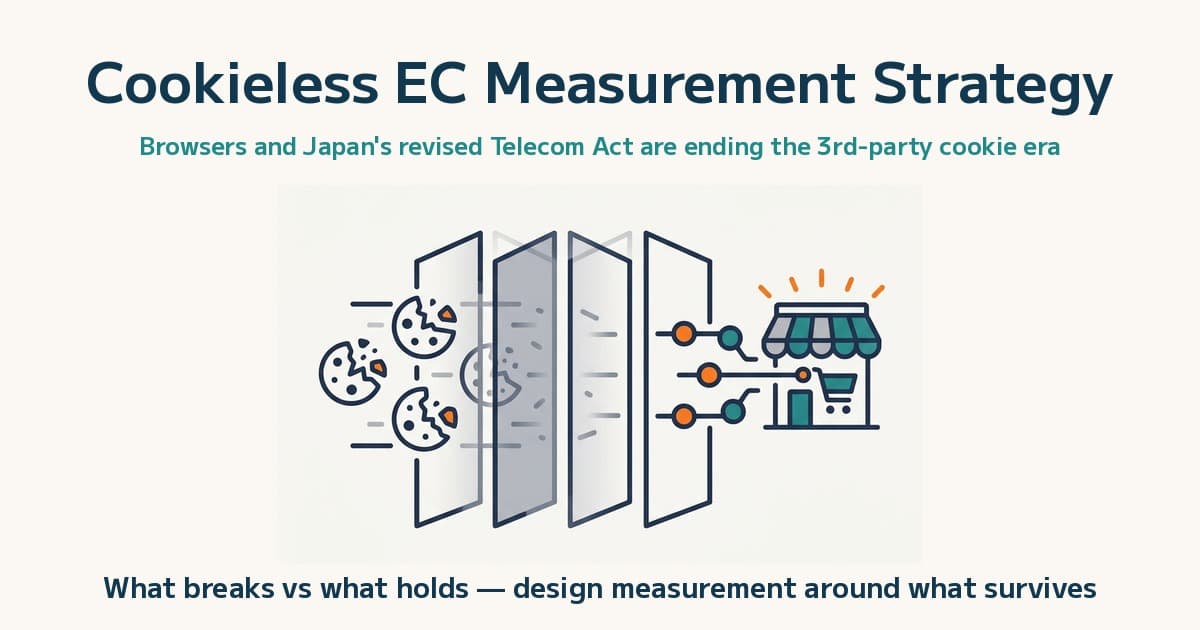
Cookieless is the only trend where "must do it" applies to every SMB EC. Apple's ITP, Mozilla's ETP, Chrome's third-party cookie phase-out — combined with Japan's revised Telecommunications Business Act (External Transmission Rules, June 2023) which mandates disclosure of cookie / tag purposes for any site using GA4 or ad tags. "We are not a telecom carrier so this does not apply" is a misreading we deconstructed in our Third-party cookie EC measurement article (Japanese only).
Main response areas:
| Area | Description | RS support |
|---|---|---|
| First-party cookie migration | Switch to own-domain cookies | ◎ Standard |
| Server-side tracking | GTM Server-Side / Cloudflare Workers | △ Alternative (via dataLayer; full-stack via separate tools) |
| Consent management | CMP, 4-item disclosure | Separate (OneTrust etc.) |
| DataLayer design | dataLayer.push event standardization | ◎ Standard |
RevenueScope's stance: standard. We use dataLayer + first-party cookies to handle Cookieless natively. EC operators who already have GA4 ecommerce setup (purchase events via dataLayer.push) can continue revenue measurement with zero additional configuration. Visitor and session IDs are managed in own-domain cookies, so third-party cookie loss does not affect our session and revenue counts. For 99% precision in ad measurement, you may still want server-side GTM via Stape or Cloudflare Workers.
7. Trend Priority by Revenue Range — Position Diagnosis#
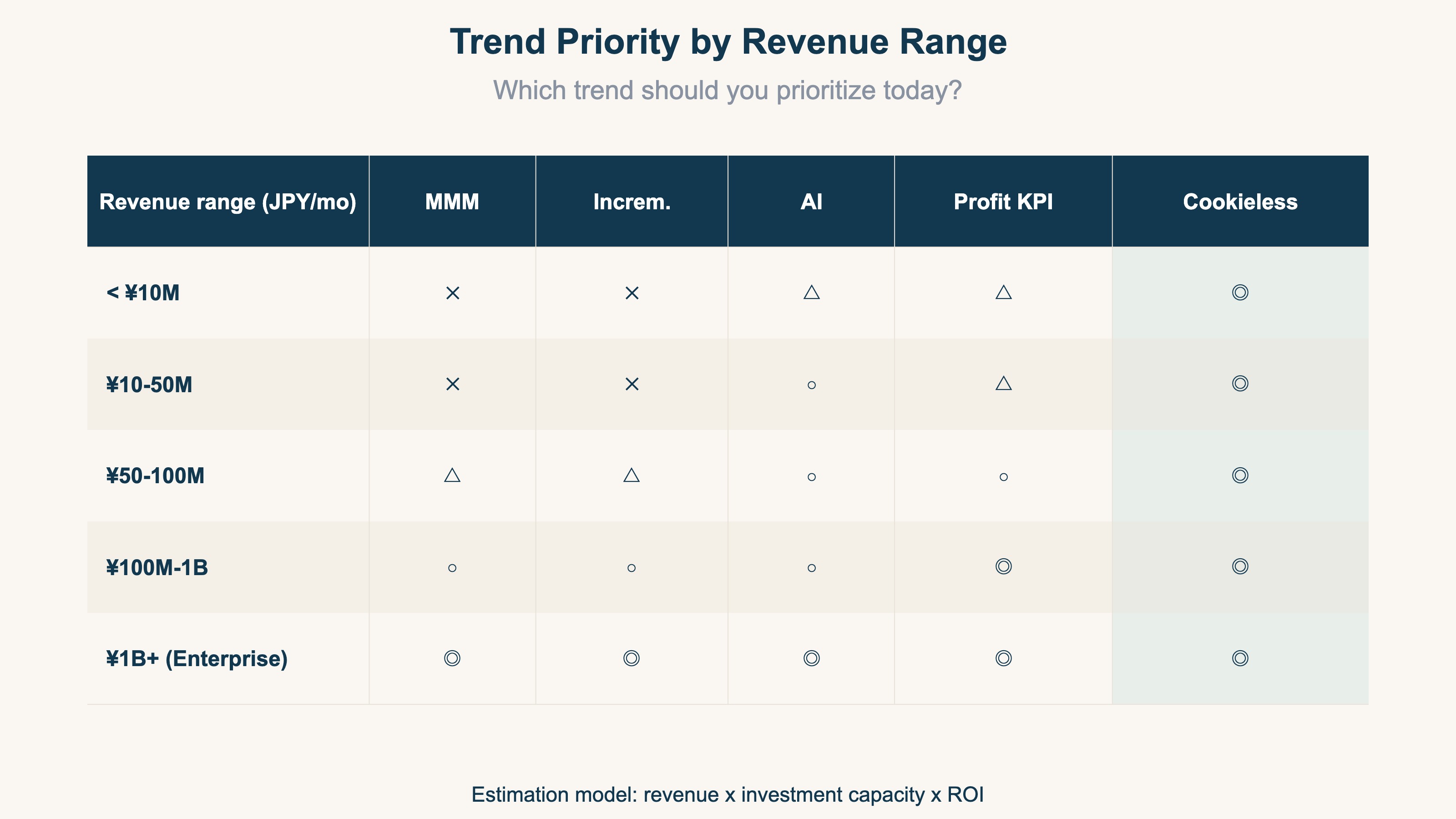
- Under ¥10M / mo: Cookieless only. MMM and incrementality are unrealistic at this stage. AI and profit KPIs are "nice to have" — focus on growing to ¥30M first. RevenueScope's standard support (dataLayer) is sufficient
- ¥10-50M / mo: Cookieless + AI. Use AI to reclaim 5-10 hours per month for ad-creative A/B tests and LP improvements. RevenueScope ships AI 5-KPI auto-summary in Q3 2026; until then, ChatGPT/Claude with dashboard screenshots is a viable workflow
- ¥50-100M / mo: + Profit-centric KPIs. Ad spend reaches a level where ROAS-only judgment masks losses. RevenueScope does not cover profit KPIs; pair with Triple Whale, Hyros, or self-built BI
- ¥100M-1B / mo: 4 of 5 trends are now relevant (Cookieless + AI + Profit KPIs + Incrementality). MMM remains gated by the 3-year data hurdle
- ¥1B+ (Enterprise): All 5 trends in scope
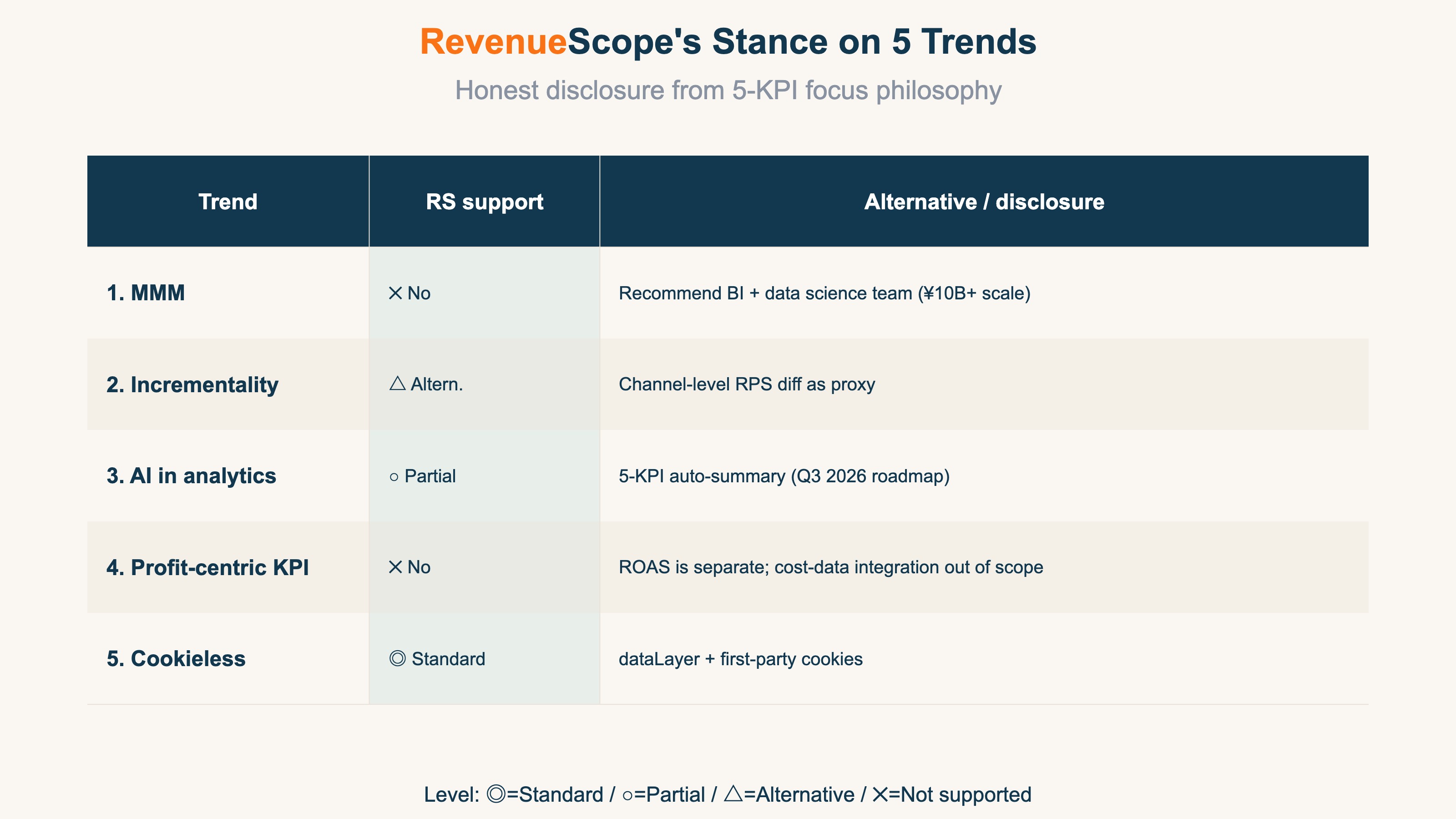
RevenueScope is optimized for SMB ECs at ¥10-50M monthly revenue. Cookieless standard + AI partial (Q3 2026) — designed for this revenue range at ¥29,800/mo. When you scale past ¥50M and need MMM or incrementality, graduating to Triple Whale or similar is the right call.
Summary#
- 2026 EC measurement landscape has 5 trends (MMM, Incrementality, AI, Profit KPIs, Cookieless)
- Only ¥1B+ enterprises should pursue all 5
- SMB ECs narrow by revenue range: under ¥10M = Cookieless only; ¥10-50M = + AI; ¥50-100M = + Profit KPIs
- RevenueScope: standard Cookieless + partial AI (Q3 2026), optimized for ¥10-50M SMB ECs
- Graduate to Triple Whale or Looker Studio when MMM, Incrementality, or Profit KPIs become required
The fear of "missing the 2026 trends" leads SMB ECs into ROI-destroying over-investment. Narrowing to 1-2 trends by your revenue scale is the essence of 2026 EC measurement strategy. See pricing and About — Revenue First philosophy for product details. For KPI design fundamentals, see Marketing KPI design (Japanese only); for ROAS basics, see ROAS complete guide (Japanese only).
RevenueScope solution
Bottom line: RevenueScope is for practicing what this article argues — not chasing every trend. Rather than piling on flashy features, it brings revenue-first metrics (RPS, AOV, CVR, revenue, sessions) onto one screen, building the foundation to decide where to invest next with your own numbers.
As noted in the body, it does not carry MMM or profit-centric KPIs (gross margin, LTV) — those belong to other tools, and the right move is to pick a dedicated one once you reach that scale. RevenueScope complements GA4 rather than replacing it, and connects read-only. It's designed around low setup friction — "one tag, five minutes."
See which ads actually drive revenue, at a glance
Free up to 5,000 sessions/month, AI connection included. No credit card required. Up and running in 5 minutes.
References#
[1] Adverity "Marketing Predictions for 2026: Where AI Delivers and Where It Breaks" Dec 2025
[2] Adverity "Data Quality for AI Readiness: A Practical Guide for Marketers" Mar 2026
[3] Adverity "Marketing Mix Modeling Fireside Chat with Labelium: Key Takeaways" Feb 2025
[4] Google "Meridian — Open-source Marketing Mix Modeling" 2024
[5] Adverity "The Currency of Action: Introducing Adverity Intelligence" Dec 2025
[6] METI "FY2024 Survey on Electronic Commerce Market" Aug 2025 (Japanese only)
[7] MIC "Guidelines on Personal Information Protection in Telecommunications Business (External Transmission Rules)" 2023 (Japanese only)